Eugen Soloviov
Trading-systems engineer
Trading-systems engineer building bots since 2017: cross-exchange arbitrage (connected up to 30 venues), cointegration-based pairs arbitrage across spot and futures, scalping, news and sentiment-driven strategies, trend algorithms, and portfolio management and balancing algorithms. Also builds sub-millisecond order execution, big-data warehouses, backtesting engines, AI agents, and trading interfaces (incl. open-source profitmaker.cc). Stack: JS/TS, Python, Rust/Zig/Go, DevOps, backend, frontend, architecture.
Articles

The Kelly Criterion for Strategies: How to Size Positions and Allocate Capital
A strategy with positive expected value can still blow up your account if you get the bet size wrong. We walk through the Kelly criterion from deriving the formula to a portfolio of strategies: why full Kelly is dangerous, how fractional Kelly captures 75% of the growth at half the volatility, and an interactive calculator that shows how the Kelly fraction moves return and risk.

Daily Stock Analysis: An AI System That Turns a Watchlist Into a Daily Decision Dashboard
A deep dive into daily_stock_analysis by ZhuLinsen — an open-source system that fetches market data across A-shares, HK, US, and more, runs technical and news analysis through an LLM, and pushes a structured 'decision dashboard' to your messenger every trading day. Architecture, data fallback, agent strategies, limitations.

Temporal Fusion Transformers for Multi-Horizon Portfolio Forecasting
How Google's Temporal Fusion Transformer brings interpretable multi-horizon forecasting to quantitative portfolio management, with attention-based variable selection, quantile outputs, and a worked pytorch-forecasting pipeline.

Conformal Prediction for Risk-Aware Position Sizing
Distribution-free prediction intervals with guaranteed coverage. We use split conformal, jackknife+, and adaptive conformal inference to calibrate trading risk and size positions without parametric assumptions.

Bid-Ask Spread Modeling and Prediction with Machine Learning
Decomposing and predicting bid-ask spreads with ML — from Roll's implicit estimator to gradient boosting and neural networks — with the units, leakage, and benchmarking pitfalls that bite in production.

DeepLOB: Deep Learning on Limit Order Books
How DeepLOB combines a CNN, an inception module, and an LSTM to predict mid-price moves from raw order book data — the architecture, the real FI-2010 numbers, and a working PyTorch reimplementation.

Inside Our House Algorithm: HRP + Long/Short + CVaR with Hull-White
A deep dive into Pipeline — the composite allocation algorithm we built on top of HRP. Hierarchical Risk Parity as the base, a long/short overlay driven by agent signals and confidence, and a final risk correction via CVaR with a Hull-White volatility adjustment. The full math from our spec, plus the actual Rust implementation.

12 Portfolio Optimization Algorithms, Compared: HRP, Black-Litterman, NCO and Beyond
One basket of crypto, twelve allocation algorithms, one honest comparison. We open-sourced a Rust portfolio optimizer that runs HRP, HERC, MVO, Black-Litterman, NCO, Entropy Pooling and more behind a single interface — here is how each one thinks and why no single winner exists.
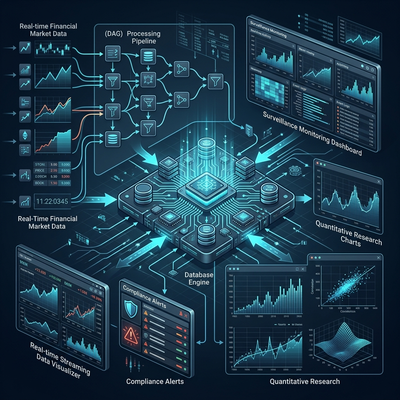
OneTick: The Platform Where Exchanges Catch Spoofers and Hedge Funds Hunt Alpha
Architecture of OneTick — an enterprise-grade time-series engine for tick data. DAG queries via Event Processors, unified real-time and historical data, market surveillance (MiFID II, MAR, SEC), TCA, quant research, and comparison with kdb+.
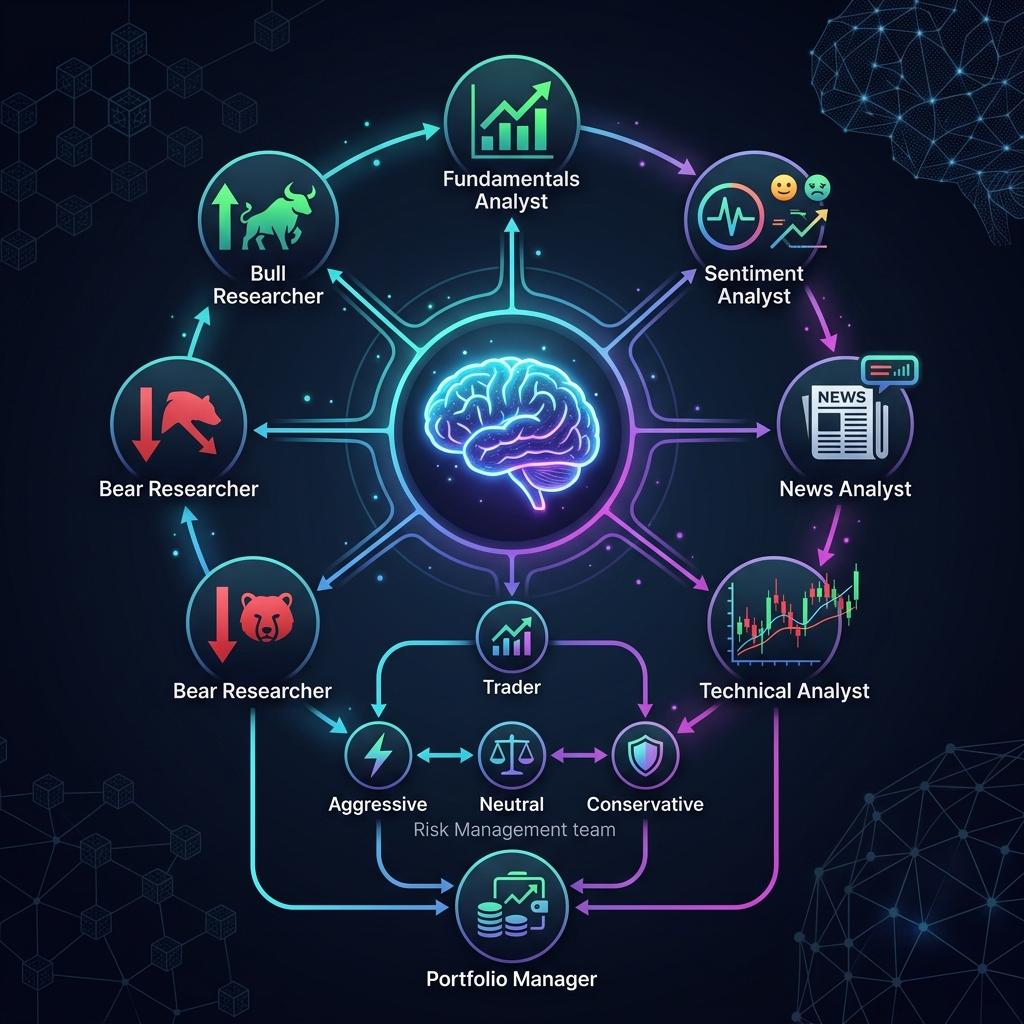
TradingAgents: Multi-Agent AI Framework That Models a Hedge Fund
Architecture deep dive into TradingAgents — an open-source LangGraph framework where LLM agents (analysts, researchers, trader, risk management, portfolio manager) engage in structured debates to make trading decisions.

Prediction Market Arbitrage: Hidden Costs, Fees, and the Real Math
Breaking down arbitrage between Polymarket, Limitless, Predict.fun, Opinion, and Kalshi. Dynamic fees, cross-chain bridges, slippage, resolution risk — and why a 5% spread may still lose money.

T-Bricks (Broadridge): How the Platform Powering Prop Firms Works
Architecture of T-Bricks — a modular HFT platform in C++ for market making, ETF arbitrage, and centralized risk management. 100+ clients, 150+ exchanges, nanosecond latencies.