Eugen Soloviov
Trading-systems engineer
Trading-systems engineer building bots since 2017: cross-exchange arbitrage (connected up to 30 venues), cointegration-based pairs arbitrage across spot and futures, scalping, news and sentiment-driven strategies, trend algorithms, and portfolio management and balancing algorithms. Also builds sub-millisecond order execution, big-data warehouses, backtesting engines, AI agents, and trading interfaces (incl. open-source profitmaker.cc). Stack: JS/TS, Python, Rust/Zig/Go, DevOps, backend, frontend, architecture.
Articles

QuestDB for Algorithmic Trading: Architecture That Speaks the Language of Markets
Deep dive into QuestDB's three-tier storage architecture — WAL, columnar storage, and Parquet on object storage — and schema design principles for algorithmic trading systems.

Data Communication in Algo Trading Systems: A Technology Overview
We analyze communication technologies at all levels of an algorithmic trading platform: from exchange connectivity protocols (REST, WebSocket, FIX) to internal IPC, message brokers, and data stores.

Loss-Profit Asymmetry: The Math That Kills Your Deposit
Why losing 50% requires 100% growth to recover, how volatility drag destroys capital even in sideways markets, and which formulas every algo trader must know for building risk management.

Complex Arbitrage Execution in Rust: From Nanoseconds to Atomic Multi-Legs
How to squeeze maximum performance out of Rust for multi-leg arbitrage execution: io_uring, lock-free order books, LMAX Disruptor, SIMD, type-state machines, and arena allocators.

GNN, Transformers, and RL for Arbitrage: When Neural Networks Learn to Trade
How graph neural networks find arbitrage chains in 78 ms, why RL agents show 142% annual returns against 12% for rule-based bots, and how to build an integrated system in Rust.

Matrices, Tensors, and Tropical Algebra: Linear Algebra for Arbitrage Detection
How the matrix of exchange rates, eigenvalues, tropical algebra, and tensor decompositions turn cryptocurrency market chaos into clear arbitrage signals.

Vine Copulas for Arbitrage: Modeling High-Dimensional Dependencies
How to use Vine Copulas to identify hidden dependencies between dozens of crypto assets and build robust, high-dimensional statistical arbitrage strategies.

Futures-Spot Arbitrage: From Cash-and-Carry to DeFi-CeFi
How funding rates, basis, and the convergence of decentralized and centralized markets create risk-free opportunities for capital in the crypto market.

Graph Algorithms for Arbitrage Detection: From Bellman-Ford to RICH
How negative cycles, multi-asset graphs, and the RICH algorithm identify arbitrage opportunities in the deep cryptocurrency market with sub-millisecond precision.
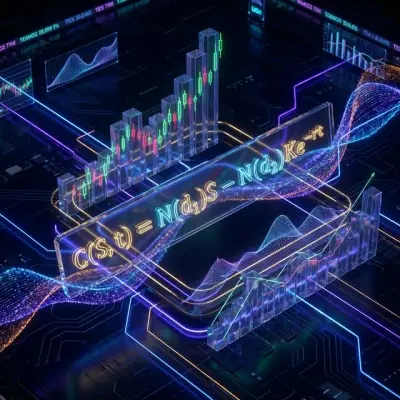
The Black-Scholes Formula: Option Mathematics and the Holy Grail of Trading
Breaking down the most famous formula in finance. How a heat equation from physics enabled option pricing and changed Wall Street forever, with Python examples.

Anomaly Detection for Trading Bot Protection: From Z-Score to Transformer
Which anomaly detection methods actually work in crypto algo trading, how to build a cascading protection architecture, and why this is the foundation without which algo trading becomes gambling.

Markowitz Portfolio Theory for Crypto: From Zero to Hero
Building optimal crypto portfolios with Python - because YOLO isn't a strategy. Learn how to apply Nobel Prize-winning portfolio theory to crypto investments with practical Python code examples.