Eugen Soloviov
Trading-systems engineer
Trading-systems engineer building bots since 2017: cross-exchange arbitrage (connected up to 30 venues), cointegration-based pairs arbitrage across spot and futures, scalping, news and sentiment-driven strategies, trend algorithms, and portfolio management and balancing algorithms. Also builds sub-millisecond order execution, big-data warehouses, backtesting engines, AI agents, and trading interfaces (incl. open-source profitmaker.cc). Stack: JS/TS, Python, Rust/Zig/Go, DevOps, backend, frontend, architecture.
Artikelen
De maker-taker-beslissing: fee tiers, rebates en de werkelijke kosten van het kruisen van de spread
Maker versus taker is een adverse-selection trade vermomd als fee schedule. Break-even wiskunde via Glosten-Milgrom, echte crypto fee tiers en token-kortingen, de geschiedenis van rebate mining, queue-afhankelijke rebate-waarde, en het modelleren van gelaagde fees in een backtest.
Implementation shortfall en zelfgebouwde TCA: meten wat executie je werkelijk kost
Perolds implementation shortfall omgezet in een werkende TCA-pipeline voor crypto-bots: arrival-price-decompositie, markout-curves op t+1s/10s/60s, ~200 regels Python over je eigen fills, en het terugvoeren van de resultaten in je backtest-kostenmodel.

Liquidaties on-chain: de mechanica van Aave en Compound, en de bot-business eromheen
Hoe liquidaties op Aave v3 en Compound daadwerkelijk werken: de wiskunde achter de health factor, close factors, liquidation bonuses, Chainlink oracle-triggers, en wat er nodig is om in 2026 een flash-loan liquidatiebot te draaien.
Uniswap v3 voor quants: geconcentreerde liquiditeit en tick-wiskunde vanaf de grondbeginselen
Hoe Uniswap v3 werkelijk werkt onder de motorkap: virtuele reserves, liquiditeit L, sqrtPriceX96, tick-wiskunde, feeGrowthInside, en waarom een LP-positie een short-volatiliteitspayoff is. Met exacte formules en een uitgewerkt numeriek voorbeeld.

Anatomie van MEV: sandwiches, frontrunning en het duistere woud van de mempool
Elke swap die je naar een publieke RPC stuurt, is een zichtbare limietorder die niemand hoeft te respecteren. Een technische uiteenzetting van hoe MEV-extractie werkt: ordening in de mempool, sandwich-wiskunde op Uniswap v2, PGA's, Flashbots en verdedigingsstrategieen voor traders.
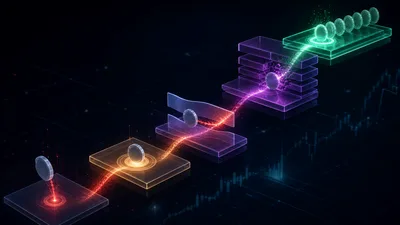
Fill-simulatie: de ladder van close-price-fantasie naar queue-aware realiteit
Vijf treden van fill-simulatiefideliteit — van close-price fills tot probabilistische queue-position modellen. Partial fills als state machine, limit-fill probability bounds als PnL-bracket, en een calibratielus tegen live fills.
TWAP versus VWAP versus POV: een executiebenchmark kiezen (en weten wanneer elk je voorliegt)
TWAP, VWAP en POV zijn allemaal weddenschappen op een volumeprognose. We ontleden de verborgen aannames van elke scheduler, bouwen intraday volumecurves voor crypto en laten alle drie tegen elkaar los op gerepliceerde L2-data.
Almgren-Chriss zonder de vaagheid: optimale executie die je in een middag kunt implementeren
Volledige afleiding van het Almgren-Chriss-model voor optimale executie: lineaire impact, de sinh/cosh-trajectorie, de efficiënte grens, en werkende Python om eta, gamma en sigma te kalibreren op basis van Binance L2- en tradedata.
Het Eerlijke Negatieve Resultaat: Tienduizenden Backtests, Vijf Grote Munten, Geen Robuuste Edge
Het sluitstuk van de zoek-en-overfit-boog, en het eindigt in een negatief resultaat — het juiste. Een single-symbol dual-timeframe-zoektocht op ETHUSDT vond een configuratie ter waarde van +16.35% out-of-sample en +2.62% op een ongebruikte holdout; de Deflated Sharpe Ratio, rekening houdend met ~37,000 trials, deflateerde dit tot 0.00. Een cross-instrument-doorloop over vijf grote munten (ETH/BTC/SOL/BNB/XRP, elk ~1.18M 1m-bars), selecterend op mediaan out-of-sample, maakt er definitief korte metten mee: dual DSR 0.24 / PBO 0.264, triple DSR 0.14 / PBO 0.327 — beide falen op de gates. De kampioen is winstgevend op 1 van de 5 symbolen en negatief op de rest. Hier is het anti-overfitting-apparaat voor bedoeld: om te voorkomen dat je de beste van de ruis als alpha shipt.
Bewijzen dat multi-timeframe backtests geen look-ahead vertonen: verstoor de toekomst, bewijs dat het verleden de toekomst niet kan zien
Multi-timeframe backtests lekken de toekomst door een nog vormende higher-timeframe bar waarvan de uiteindelijke close nog niet bestaat. Je kunt niet via code review naar vertrouwen toe redeneren — je moet het testen. We reproduceren de closed-bar regel van de live bot exact, en bewijzen vervolgens de afwezigheid van lekkage met een shifted-future probe: verstoor elke toekomstige bar en toon aan dat elk signaal en elke trade uit het verleden bitwise ongewijzigd blijft. 25/25 parity checks, en de probe heeft tanden.
Wanneer de GPU loont: de parameter-sweep-roofline, waar een headline van 167x in werkelijkheid 27x algoritme maal 6.2x hardware is
De voorsprong van de GPU op de CPU groeit met de batchgrootte — van 54.5x bij een combo per call tot 359.6x bij 61 op onze multi-timeframe indicator-precompute — omdat een kleine sweep de kernel-launch- en transfer-overhead niet kan amortiseren. We ontleden een headline van 167x in een algoritmische winst van 27x die ook de CPU helpt en een hardwarewinst van 6.2x, laten zien dat de echte voorsprong van de GPU op de beste CPU slechts 3.2x is bij single-timeframe en 6.2x bij multi, en geven een beslisgids voor hoe breed een sweep moet zijn voordat een GPU de aanschaf waard is.
De GPU-precisievalstrik: Hoe een fp32-backtest op Apple Metal stilletjes onzin teruggeeft
Apple's Metal-GPU heeft geen float64. Zet er naïef een gevectoriseerde backtest naartoe over en de verleidelijke prefixsom-WMA loopt over fp32 heen — maximale relatieve fout 211× — en toch draait hij nog steeds en geeft plausibel ogende getallen terug. De oplossing is niet meer precisie; het is een andere formulering: een directe gevensterde convolutie, fp32-veilig tot 8×10⁻⁷ en 55.9× sneller dan single-thread numba. De valstrik, de rekenkunde, en hoe je bewijst dat je er niet in getrapt bent.