Eugen Soloviov
Trading-systems engineer
Trading-systems engineer building bots since 2017: cross-exchange arbitrage (connected up to 30 venues), cointegration-based pairs arbitrage across spot and futures, scalping, news and sentiment-driven strategies, trend algorithms, and portfolio management and balancing algorithms. Also builds sub-millisecond order execution, big-data warehouses, backtesting engines, AI agents, and trading interfaces (incl. open-source profitmaker.cc). Stack: JS/TS, Python, Rust/Zig/Go, DevOps, backend, frontend, architecture.
Articles

La decisión maker-taker: niveles de comisiones, rebates y el verdadero costo de cruzar el spread
Maker vs taker es una operación de selección adversa disfrazada de esquema de comisiones. Matemática del punto de equilibrio vía Glosten-Milgrom, niveles de comisiones reales en cripto y descuentos por token, historia del rebate mining, valor del rebate condicionado a la cola, y cómo modelar comisiones escalonadas en un backtest.
Implementation shortfall y TCA casero: midiendo lo que la ejecución realmente te cuesta
El implementation shortfall de Perold convertido en un pipeline de TCA funcional para bots cripto: descomposición del precio de llegada, curvas de markout en t+1s/10s/60s, ~200 líneas de Python sobre tus propios fills, y cómo retroalimentar los resultados a tu modelo de costos de backtest.

Liquidaciones on-chain: la mecánica de Aave y Compound, y el negocio de los bots alrededor de ellas
Cómo funcionan realmente las liquidaciones en Aave v3 y Compound: la matemática del health factor, los close factors, los bonos de liquidación, los disparadores del oráculo de Chainlink y lo que hace falta para operar un bot de liquidación con flash loans en 2026.
Uniswap v3 para quants: liquidez concentrada y matemática de ticks desde primeros principios
Cómo funciona realmente Uniswap v3 por dentro: reservas virtuales, liquidez L, sqrtPriceX96, matemática de ticks, feeGrowthInside, y por qué una posición de LP es un payoff corto en volatilidad. Con fórmulas exactas y un ejemplo numérico resuelto.

Anatomía del MEV: sandwiches, frontrunning y el bosque oscuro del mempool
Cada swap que envías a un RPC público es una orden límite visible que nadie está obligado a respetar. Un análisis técnico de cómo funciona la extracción de MEV: ordenamiento del mempool, matemática del sandwich en Uniswap v2, PGAs, Flashbots y defensas para traders.
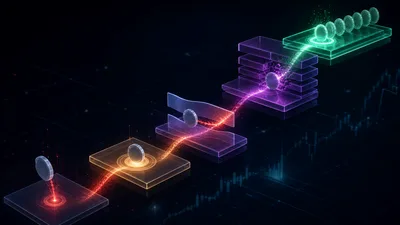
Simulación de fills: la escalera desde la fantasía del precio de cierre hasta la realidad consciente de la cola
Cinco peldaños de fidelidad en la simulación de fills — desde fills al precio de cierre hasta modelos probabilísticos de posición en cola. Fills parciales como máquina de estados, límites de probabilidad de fill como banda de PnL, y un bucle de calibración contra fills en vivo.
TWAP vs VWAP vs POV: cómo elegir un benchmark de ejecución (y saber cuándo cada uno te miente)
TWAP, VWAP y POV son apuestas sobre un pronóstico de volumen. Diseccionamos los supuestos ocultos de cada programador de órdenes, construimos curvas de volumen intradía para cripto y enfrentamos a los tres cara a cara sobre datos L2 replayeados.

Almgren-Chriss sin rodeos: ejecución óptima que puedes implementar en una tarde
Derivación completa del modelo de ejecución óptima de Almgren-Chriss: impacto lineal, la trayectoria sinh/cosh, la frontera eficiente y código Python funcional para calibrar eta, gamma y sigma a partir de datos de L2 y operaciones de Binance.
El negativo honesto: decenas de miles de backtests, cinco majors, ninguna ventaja robusta
El cierre del arco de búsqueda y sobreajuste, y termina en un resultado negativo — el correcto. Una búsqueda de doble timeframe sobre un solo símbolo (ETHUSDT) encontró una configuración con +16.35% fuera de muestra y +2.62% en un holdout intacto; el ratio de Sharpe deflactado, contando ~37,000 pruebas, lo deflactó a 0.00. Una pasada entre instrumentos sobre cinco majors (ETH/BTC/SOL/BNB/XRP, ~1.18M de barras de 1m cada uno), seleccionando por la mediana fuera de muestra, lo remata definitivamente: doble DSR 0.24 / PBO 0.264, triple DSR 0.14 / PBO 0.327 — ambos fallan los filtros. El campeón es rentable en 1 de 5 símbolos y negativo en el resto. Para esto existe el aparato anti-sobreajuste: para impedir que despliegues el mejor del ruido como alfa.
Demostrando la ausencia de look-ahead en backtests multi-timeframe: perturbar el futuro para probar que el pasado no puede verlo
Los backtests multi-timeframe filtran el futuro a través de una vela de temporalidad superior en formación, cuyo cierre final aún no existe. No se puede llegar a la confianza mediante revisión de código — hay que probarlo. Reproducimos exactamente la regla de vela cerrada del bot en vivo, y luego demostramos que no hay filtración con una sonda de futuro desplazado: perturbamos cada vela futura y verificamos que cada señal y operación pasada permanece idéntica bit a bit. 25/25 comprobaciones de paridad superadas, y la sonda tiene mordiente.

Cuándo Compensa la GPU: El Roofline del Sweep de Parámetros, Donde un Titular de 167x Es en Realidad 27x de Algoritmo por 6.2x de Hardware
La ventaja de la GPU sobre la CPU crece con el tamaño del batch — de 54.5x con un combo por llamada hasta 359.6x con 61 en nuestro precómputo de indicadores multi-timeframe — porque un sweep pequeño no puede amortizar el overhead de lanzamiento de kernels y de transferencia. Descomponemos un titular de 167x en una victoria algorítmica de 27x que también ayuda a la CPU y una victoria de hardware de 6.2x, mostramos que la ventaja real de la GPU frente a la mejor CPU es solo 3.2x en single-timeframe y 6.2x en multi, y damos una guía de decisión sobre cuán ancho debe ser un sweep antes de que valga la pena apostar por una GPU.
La trampa de precisión de la GPU: cómo un backtest en fp32 sobre Apple Metal devuelve basura en silencio
La GPU Metal de Apple no tiene float64. Porta un backtest vectorizado a ella de forma ingenua y la tentadora WMA por suma de prefijos desborda fp32 —error relativo máximo de 211×— y aun así se ejecuta y devuelve números de aspecto plausible. La solución no es más precisión; es una formulación distinta: una convolución directa por ventanas, segura en fp32 hasta 8×10⁻⁷ y 55.9× más rápida que numba de un solo hilo. La trampa, la aritmética y cómo demostrar que no caíste en ella.