Collections
Curated reading paths through the blog, ordered from basics to advanced.

Backtesting Without Fooling Yourself
A step-by-step path from what your backtest really optimizes to proving an edge survives overfitting, multiple testing, and live execution. Read top to bottom — each part builds on the last.
- 01Conception de la fonction objectif : la métrique que vous optimisez choisit secrètement votre stratégie
- 02Prouver l'absence de look-ahead dans les backtests multi-timeframe : perturber le futur pour prouver que le passé ne peut pas le voir
- 03Look-Ahead Bias : comment une erreur d'une bougie fabrique un Sharpe de 15 à partir de pur bruit
- 04Walk-Forward Optimization: The Only Honest Strategy Test
- +7 more

High-Performance Backtest Engines
How to build a backtest engine that runs hundreds of times faster without changing a single PnL number — data layout, caching, adaptive resolution, and architecture, from first speedups to production internals.
- 01L'échelle de vitesse du backtest : 298x sur le CPU d'un portable, PnL identique jusqu'au dernier trade
- 02La taxe du framework : quand votre bibliothèque de backtest est plus lente qu'une boucle pandas naïve
- 03Cache Parquet Agrégé : Comment Accélérer les Backtests Multi-Timeframe des Centaines de Fois
- 04L'espace de parametres a deux axes : pourquoi la majeure partie de votre balayage devrait etre quasi gratuite
- +7 more
Complex Arbitrage in Rust
A six-part build-up of multi-leg crypto arbitrage — from negative-cycle detection to the linear algebra, copulas, and machine learning behind it, ending in low-latency Rust execution.
- 01Algorithmes de graphes pour la détection d'arbitrage : de Bellman-Ford à RICH
- 02Arbitrage Futures-Spot : Du Cash-and-Carry au DeFi-CeFi
- 03Matrices, tenseurs et algèbre tropicale : l'algèbre linéaire pour la détection d'arbitrage
- 04Vine Copulas pour l'Arbitrage : Modélisation des Dépendances en Haute Dimension
- +2 more
Order Book & Market Microstructure
How the order book really works — accessing the data, reading queue position, rebuilding bars from order flow, and modeling it with deep learning and Hawkes processes.
- 01CCXT : comment fonctionnent réellement les méthodes WebSocket de carnet d'ordres
- 02Types d'ordres dans le trading algorithmique : de la limite avec poursuite aux ordres virtuels
- 03Queue Inside the Wall: Analyzing Order Position in Order Book Density
- 04Types de Barres et Méthodes d'Agrégation pour le Trading Algorithmique
- +8 more

Portfolio Construction & Risk
From Markowitz to production HRP + CVaR: how to allocate across crypto assets, model tail dependence with copulas, and size positions without blowing up.
- 01Théorie de portefeuille de Markowitz pour la crypto : de zéro à héros
- 0212 algorithmes d'optimisation de portefeuille comparés : HRP, Black-Litterman, NCO et au-delà
- 03Dans notre algorithme maison : HRP + Long/Short + CVaR avec Hull-White
- 04Modèles de copules pour la modélisation conjointe du risque dans les portefeuilles crypto
- +1 more

Risk & Position Sizing
Build position sizes from drawdown math, realistic trading costs, and uncertainty in backtest results before applying Kelly.
- 01Asymétrie Perte-Profit : Les Mathématiques qui Détruisent votre Dépôt
- 02Courbes de slippage, pas constantes de slippage : des modèles de coûts qui survivent au contact du trading réel
- 03Bootstrap Monte Carlo : comment obtenir des intervalles de confiance pour un backtest en 10 lignes de code
- 04Le critère de Kelly pour les stratégies : comment dimensionner les positions et allouer le capital
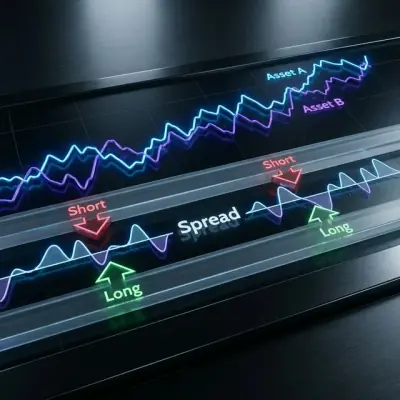
Statistical Arbitrage & Pairs Trading
Trade the spread between correlated assets — from the distance approach to cointegration and Kalman filters, then dynamically combining mean reversion with momentum.
- 01Approche par distance dans le pairs trading : implémentation et analyse avec Rust
- 02Statistical Arbitrage and Pairs Trading in Crypto Markets: From Cointegration to the Kalman Filter
- 03Signal Correlation: How Many Pairs to Monitor
- 04Combiner dynamiquement les stratégies de retour à la moyenne et de momentum dans l'arbitrage statistique : fondements mathématiques et mise en œuvre pratique
- +1 more

Deep Learning for Markets
Neural forecasting for crypto — transformers, diffusion models, and foundation models, and how conformal prediction keeps their uncertainty honest.
- 01Temporal Fusion Transformers for Multi-Horizon Portfolio Forecasting
- 02Les modèles de diffusion contre l'anarchie des cryptomonnaies : pourquoi DDPM prédit les crashs de Bitcoin mieux que votre astrologue
- 03Kronos : un modèle de fondation qui apprend aux chandeliers japonais à parler le langage des transformers
- 04Prédiction conforme pour un dimensionnement de position tenant compte du risque
AI Agents for Trading
The agentic-AI stack for markets — multi-agent frameworks, open-source hedge funds, and LLMs that mine alpha from earnings calls.
- 01Révolution dans la gestion de portefeuilles d'investissement grâce à l'IA agentique
- 02TradingAgents: Multi-Agent AI Framework That Models a Hedge Fund
- 03AI4Finance Foundation : l'écosystème FinGPT, FinRL et FinRobot pour le trading algorithmique
- 04AI Hedge Fund : un fonds multi-agents où des analystes IA votent sur les transactions
- +1 more

QuestDB for Algorithmic Trading
Stand up a time-series stack for trading on QuestDB — from architecture to the SQL that matters, to a production deployment.
- 01QuestDB for Algorithmic Trading: Architecture That Speaks the Language of Markets
- 02QuestDB for Algorithmic Trading: SQL Extensions That Change the Game
- 03QuestDB for Algorithmic Trading: From Order Books to Production Architecture

Low-Latency Trading Infrastructure
The plumbing under an HFT stack — how components talk (WebSocket, FIX, gRPC, Aeron), messaging on Aeron and Zig, and a C++ FIX/FAST scalper.
- 01Communication des données dans les systèmes de trading algorithmique : un panorama technologique
- 02Aeron : au coeur du systeme de messagerie qui fait tourner la moitie de l'industrie HFT
- 03ZigBolt: Why We Built Our Own Aeron in Zig and Hit 20 Nanoseconds Per Message
- 04Developing a Simple C++ Scalper Using FAST/FIX: Step-by-Step Guide

Execution & Market Making
From TWAP/VWAP and Almgren-Chriss to TCA, slippage models, and the Avellaneda-Stoikov market maker — how to turn a signal into fills without paying the spread twice.
- 01TWAP vs VWAP vs POV : choisir un benchmark d'exécution (et savoir quand chacun vous ment)
- 02Almgren-Chriss sans approximations : l'exécution optimale que vous pouvez implémenter en un après-midi
- 03Dans la tranche : les tactiques d'ordres enfants entre votre scheduler et l'exchange
- 04Smart Order Routing en crypto : un ordre, douze venues, aucun NBBO
- +7 more

Onchain & DeFi Quant
Quantitative DeFi from first principles — MEV and sandwich attacks, atomic arbitrage, liquidation cascades on lending protocols, and LP profitability on Uniswap v3.
- 01Anatomie du MEV : sandwiches, frontrunning et la forêt obscure du mempool
- 02La chaîne d'approvisionnement du MEV : PBS, MEV-Boost et qui capture réellement la valeur
- 03Arbitrage on-chain : cycles atomiques, flash loans et l'enchère que vous devez gagner
- 04Liquidations on-chain : mécanique d'Aave et Compound, et le business des bots qui l'entoure
- +5 more

Causality & Lead-Lag in Markets
Who moves whom — Granger causality, transfer entropy, PCMCI discovery, and the causal ML toolbox (double ML, causal forests, synthetic control) applied to crypto markets.
- 01Toda-Yamamoto vs Differenced Granger: Does the BTC Lead-Lag Survive?
- 02Transfer Entropy: Which Way Does Information Flow Between Crypto Assets?
- 03PCMCI: Causal Discovery in Multivariate Crypto Time Series
- 04Forêts causales pour effets de traitement hétérogènes dans le trading
- +3 more

Volatility Modeling & Regimes
Forecast volatility with the GARCH family — asymmetry and leverage effects, dynamic correlations, vol targeting — then detect market regimes with HMMs and trade adaptively.
- 01GARCH(1,1) : prévoir la volatilité crypto
- 02GARCH asymétrique et à queues épaisses : EGARCH, GJR et Student-t
- 03DCC-GARCH : corrélations dynamiques pour les paires et le risque de portefeuille
- 04Ciblage de volatilité et trading avec les prévisions GARCH
- +1 more

Modern ML for Trading
The full gradient-boosting-to-neural-operator toolkit — ensembles, AutoML, probabilistic forecasting, distillation and pruning for latency, plus physics-informed architectures like Neural ODEs and Fourier operators.
- 01XGBoost for Return Direction: Class Imbalance and Decision Thresholds
- 02Méthodes d'ensemble : combiner des apprenants faibles pour une alpha robuste
- 03AutoML pour les pipelines de trading systématique
- 04Multi-Task Learning for Simultaneous Price, Volume, and Volatility Prediction
- +11 more