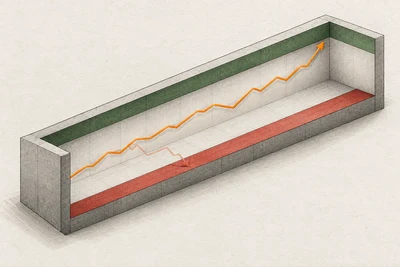
На счете 50 тысяч, потерять можно две: считаем риск prop challenge
Практический разбор prop challenge: как читать лимиты, считать вероятность прохождения и выбирать размер позиции. Учебный пример, проверяемые расчеты и Python без зависимостей.
Глубокое погружение в AI-трейдинг, анализ рынка и будущее DeFi.
Смотреть подборки →Nothing found. Try a different query.
Практический разбор prop challenge: как читать лимиты, считать вероятность прохождения и выбирать размер позиции. Учебный пример, проверяемые расчеты и Python без зависимостей.
Return-direction classifiers are imbalanced problems, and 0.5 is the wrong decision threshold. Comparing scale_pos_weight, focal loss, and precision-constrained threshold optimization on crypto data — plus the engineering differences between XGBoost, LightGBM, and CatBoost.
DCC-GARCH tells you when crypto dependence tightens. Transfer entropy tells you which way it points. A directed information-flow measure, its null calibration, and an honest account of what it does and does not add over average pairwise correlation.
Reconstructing trade direction from OHLCV, bar history, or venues without an aggressor flag — the classic rules, the stale-quote problem, bulk volume classification, and how to measure them against crypto's free ground truth.
Sequence models fed tick data still assume regular spacing. Three ways to tell a Transformer when a tick actually happened — learnable-timescale continuous encoding, ODE-RNN latent state, and delta_t as a plain feature — and the ablation that decides between them.
This series has priced the selection route to a false edge — DSR prices the winner, PBO prices the search. Neither touches confounding: the strategy that made money because volatility doubled the week you deployed it. The Synthetic Control Method builds a weighted counterfactual from a donor pool of untouched instruments and gives you a falsification criterion and a placebo p-value.
How to evaluate a predictive distribution honestly — CRPS as a proper scoring rule, the PIT histogram as a calibration diagnostic, and DeepAR sampling in GluonTS.
Putting the Heston, free-boundary, and jump-diffusion pricing PDEs into a neural network loss — the log-price residual, the mixed-partial autograd trick, and what still needs measuring.