Abonniere unseren Newsletter für exklusive KI-Trading-Einblicke, Marktanalysen und Plattform-Updates.
Series "Backtests Without Illusions", Article 9
Strategy backtesting is not just about signal logic and execution simulation. It is also a data pipeline: loading millions of candles, resampling timeframes, computing indicators, filtering by conditions, grouping by instruments. When the pipeline takes 30 seconds instead of 3, it is not just an inconvenience. It means 10x fewer experiments per hour, 10x slower iteration, and a 10x longer path from idea to production.
Pandas is the de facto standard for tabular data in Python. But Pandas was designed in 2008, when CPU cores were slower and datasets were smaller. Pandas is single-threaded, memory-hungry, and lacks a query optimizer. Polars is a next-generation library written in Rust, with parallel execution, Apache Arrow at its core, and a lazy query planner.
The question: how much faster is Polars on real algotrading tasks? Not on synthetic benchmarks from a README, but on tick filtering, rolling indicator computation, grouping by instruments, and loading from Parquet/QuestDB?
This article provides systematic benchmarks with numbers, code, and practical recommendations.
Benchmark Methodology
Before comparing, let us define the rules so that results are reproducible and fair.
Each benchmark is run 100 times; the median is taken
Warmup: 5 iterations before measurements
GC disabled during measurement (gc.disable())
Data
Three levels of scale:
Small: 10K rows (one instrument, one day, minute candles)
Medium: 1M rows (one instrument, ~2 years, minute candles)
Large: 10M+ rows (100 instruments, 2 years, minute candles)
Additionally: the real NYC Taxi dataset (12.7M rows) for ETL benchmarks — a standard industry benchmark.
What We Measure
import timeit, gc
defbench(fn, n=100, warmup=5):
"""Fair benchmark: warmup + median of n runs."""for _ inrange(warmup):
fn()
gc.disable()
times = timeit.repeat(fn, number=1, repeat=n)
gc.enable()
return {
"median_ms": sorted(times)[n // 2] * 1000,
"p95_ms": sorted(times)[int(n * 0.95)] * 1000,
}
Operation Benchmarks: Tables
Small datasets (10K rows)
Operation
Pandas (ms)
Polars (ms)
Speedup
Filter
0.18
0.32
0.56x
GroupBy
1.2
0.75
1.6x
Join
5.5
0.4
13.75x
Select
0.5
0.2
2.5x
At 10K rows, Pandas is sometimes faster on simple filters — the overhead of calling a Polars function via PyO3 is comparable to the time of the operation itself. But on joins, the advantage is already visible: the Polars hash table in Rust is 13x faster.
Medium datasets (1M rows)
Operation
Pandas (ms)
Polars (ms)
Speedup
Filter
12.4
7.8
1.6x
GroupBy
45.2
28.6
1.6x
Join
89.0
14.3
6.2x
Select
21.8
2.0
10.9x
At one million rows, Polars is consistently 1.6x faster on filtering and grouping. On select (choosing a subset of columns) — 10.9x, because the Arrow columnar format allows zero-copy slicing.
Large datasets (10M+ rows)
Operation
Pandas (ms)
Polars (ms)
Speedup
Filter
185
50
3.7x
GroupBy
860
100
8.6x
Join
1450
120
12.1x
Select
240
40
6.0x
On large data, the Polars advantage grows nonlinearly: parallel execution on 8 cores and the query optimizer produce a cumulative effect. GroupBy is 8.6x faster — the difference between "waiting one second" and "waiting 100 milliseconds."
ETL on Real Data (NYC Taxi, 12.7M rows)
Operation
Pandas (s)
Polars (s)
Speedup
CSV Load
28.5
1.14
25.0x
Filter + GroupBy + Agg
3.8
0.42
9.0x
Multi-column transform
2.1
0.7
3.0x
Full ETL pipeline
34.4
2.26
15.2x
CSV I/O is the most dramatic result: Polars reads CSV in parallel on its Rust engine, 25x faster. This is critical for initial loading of historical data.
Official PDS-H Benchmark (May 2025)
PDS-H (Performance Data Science — Holistic) is a standard benchmark for DataFrame libraries, analogous to TPC-H for databases. Results from May 2025:
Pandas only participates at the SF-10 scale — single-threaded, no query optimizer, two orders of magnitude slower than the leaders
Polars and DuckDB are in their own league at SF-10 and SF-100
The new streaming engine in Polars gives an additional 3-7x speedup compared to in-memory mode — enabling processing of data that does not fit in RAM
For algotrading, this means: if your pipeline is memory-bound when loading 100M+ rows of tick data — the Polars streaming engine lets you process them without increasing RAM.
Rolling Computations for Trading Signals: The Killer Feature
This is the most important benchmark for algotrading. A typical task: you have 100 instruments, and for each you need to compute a rolling mean, rolling std, z-score, and generate a signal based on them. In Pandas this is groupby().rolling(), in Polars it is group_by().agg(col().rolling_mean()).
10x to 3500x speedup on rolling computations by group. This is not a typo. Pandas groupby().transform(lambda x: x.rolling().mean()) creates a Python loop over each group, with every call incurring interpreter overhead. Polars executes everything in Rust, in parallel across groups, without intermediate Python objects.
For a pipeline that needs to compute 10 indicators across 100 instruments — this is the difference between 2 minutes and 0.3 seconds.
TTM Squeeze is a method for identifying the market's transition from a squeeze state (low volatility) to an expansion state. The signal occurs when Bollinger Bands are inside Keltner Channels:
squeeze=BBlower>KClower∧BBupper<KCupper
Technical Indicators Benchmark (1M rows, single ticker)
Indicator
Pandas (ms)
Polars (ms)
Speedup
Bollinger Bands (20, 2)
8.4
1.2
7.0x
Keltner Channels (20, 1.5)
14.2
2.1
6.8x
TTM Squeeze (full)
28.6
4.1
7.0x
RSI (14)
6.8
1.1
6.2x
MACD (12, 26, 9)
5.2
0.8
6.5x
A consistent ~7x speedup on a single ticker. When computing by group (100 tickers), the speedup grows to hundreds of times due to Pandas groupby overhead.
A Note on Ready-Made Indicator Packages
For Pandas, there is pandas-ta — a library with 130+ indicators. For Polars, there is no equivalent package yet. This means that when using Polars, you will need to implement indicators yourself. However, the basic building blocks (rolling_mean, rolling_std, ewm_mean, shift, column arithmetic) cover the vast majority of standard indicators, and the Polars implementation is usually shorter than it seems.
I/O Benchmarks: CSV, Parquet, Database
The data pipeline starts with loading data. The storage format and reading method determine the baseline speed of the entire pipeline.
CSV: Polars up to 25x faster — parallel parsing in Rust
Parquet read: Polars is 2.6x faster on full read and 4.5x with projection pushdown (reading only needed columns)
Parquet write: nearly identical — both use PyArrow/Arrow backend
Lazy scan: Polars can apply the filter at the Parquet file row group level without loading data into memory. This is impossible with Pandas without manually using PyArrow
For the Parquet cache — our primary format for storing precomputed timeframes and indicators — Polars with lazy evaluation provides ideal integration: loading only the needed columns and periods without reading the entire file into memory.
Memory Consumption and Lazy Evaluation
Eager vs Lazy
Pandas works only in eager mode: every operation executes immediately, and intermediate results are materialized in memory.
Projection pushdown: reads only 3 columns instead of all
Predicate pushdown: applies the volume > 1000 filter during reading, without loading unnecessary rows
Common subexpression elimination: avoids computing the same thing twice
Memory Consumption (10M rows, 6 float64 columns)
Scenario
Pandas (GB)
Polars eager (GB)
Polars lazy (GB)
CSV Load
0.92
0.46
0.46
Filter + Select 3 columns
1.38*
0.22
0.22
Pipeline of 5 transformations
2.76*
0.48
0.48
Parquet Load (3 of 6 cols)
0.46
0.23
0.23
* Pandas creates intermediate copies; inplace=True helps partially, but not for all operations.
Polars natively uses the Arrow columnar format: data is stored by columns, rows are not duplicated, and zero-copy operations are used wherever possible. For pipelines with multiple transformations, Polars consumes 2-6x less memory.
Streaming Engine: Data Larger Than RAM
For datasets that do not fit in RAM, Polars offers a streaming engine:
The streaming engine processes data in chunks without loading the entire dataset into memory. According to PDS-H benchmark data, streaming mode is 3-7x faster than in-memory on large scales — thanks to better cache locality and the absence of virtual memory pressure.
Hybrid Architecture: Polars + Numba
A backtest consists of two fundamentally different parts:
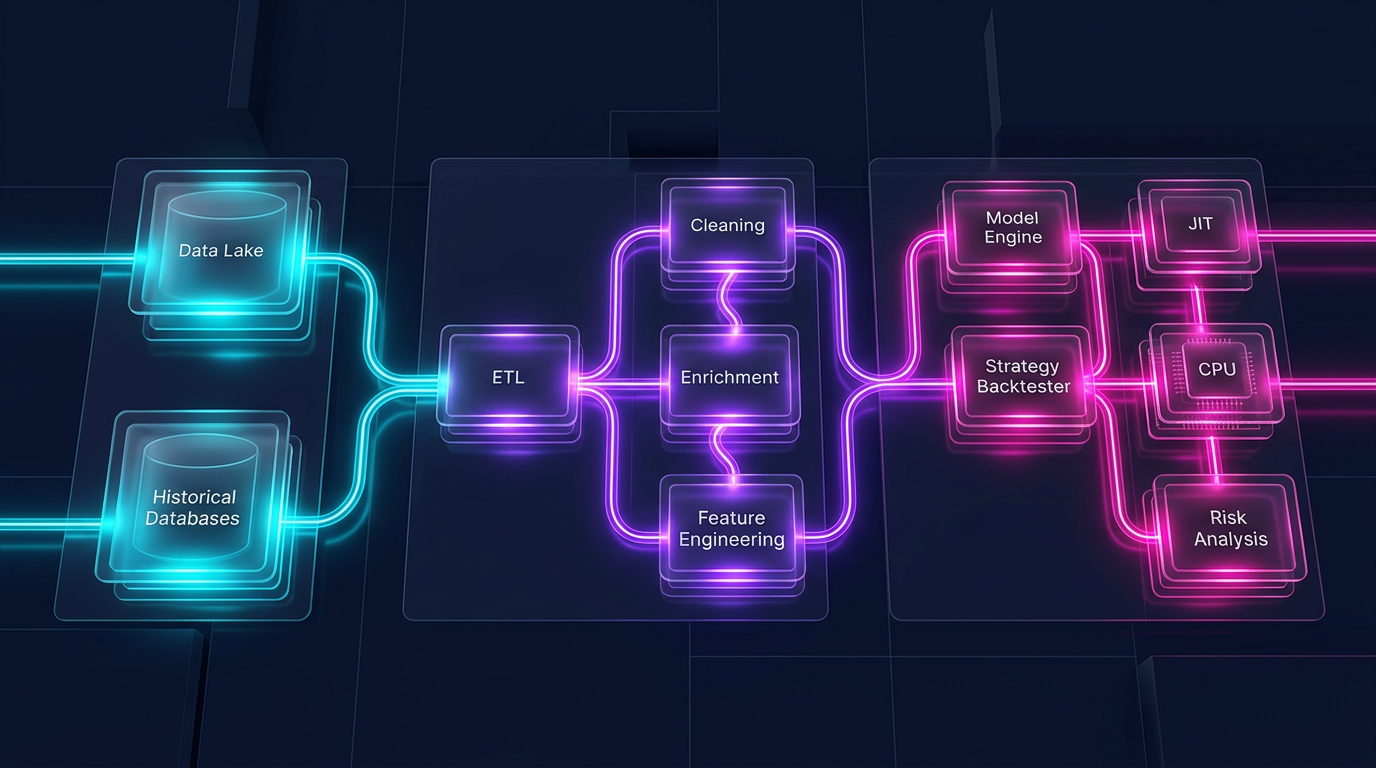
Data pipeline — loading, transformation, indicators, filtering. This is massively parallel, column-oriented, and perfectly suited for Polars.
Portfolio simulation — order filling, PnL computation, position management. This is path-dependent: each step depends on the previous state. This requires an element-wise pass over the time series.
Pandas is poorly suited for both parts. Polars excels at the first but not the second. For path-dependent logic, the optimal tool is Numba (a JIT compiler for Python) or native Rust/C++.
import polars as pl
import numpy as np
from numba import njit
df = (
pl.scan_parquet("cache_ETHUSDT_2024_2026.parquet")
.filter(pl.col("timestamp").is_between(start, end))
.with_columns([
pl.col("close")
.rolling_mean(window_size=20)
.alias("ma_fast"),
pl.col("close")
.rolling_mean(window_size=50)
.alias("ma_slow"),
pl.col("close")
.rolling_std(window_size=20)
.alias("volatility"),
])
.with_columns(
((pl.col("ma_fast") - pl.col("ma_slow")) / pl.col("volatility"))
.alias("signal")
)
.collect()
)
prices = df["close"].to_numpy() # zero-copy from Arrow
signals = df["signal"].to_numpy() # zero-copy from Arrow@njitdefsimulate_strategy(prices, signals, threshold=1.5, stop_loss=0.02):
"""
Path-dependent simulation: Numba compiles to machine code.
1M iterations in 70-100ms.
"""
n = len(prices)
equity = np.empty(n)
equity[0] = 1.0
position = 0.0
entry_price = 0.0for i inrange(1, n):
if position != 0.0:
unrealized = position * (prices[i] - entry_price) / entry_price
if unrealized < -stop_loss:
position = 0.0if position == 0.0:
if signals[i] > threshold:
position = 1.0
entry_price = prices[i]
elif signals[i] < -threshold:
position = -1.0
entry_price = prices[i]
ret = (prices[i] - prices[i - 1]) / prices[i - 1]
equity[i] = equity[i - 1] * (1.0 + position * ret)
return equity
equity = simulate_strategy(prices, signals)
Why Not vectorbt?
vectorbt is a popular backtesting framework that processes 1M orders in 70-100ms. It is built on Pandas + NumPy + Numba. The problem: Pandas is the bottleneck in the data pipeline — slow, single-threaded, memory-hungry. vectorbt has to work around Pandas limitations through Numba for critical parts, but data loading and indicator computation still go through Pandas.
The hybrid Polars + Numba architecture takes the best of both worlds:
Polars for the data pipeline — 5-350x faster than Pandas on the same operations
Numba for portfolio simulation — the same speed as in vectorbt
No intermediate Pandas layer — data flows from Arrow directly to NumPy via zero-copy
Migration: Key Patterns from Pandas to Polars
If your pipeline is written in Pandas, migration does not require rewriting from scratch. The main patterns translate via templates.
Polars natively works with Apache Arrow — the same format that QuestDB uses for data transfer. This means zero-copy when receiving query results:
import pyarrow as pa
from questdb.ingress import Sender

arrow_table = questdb_connection.query_arrow(
    "SELECT * FROM candles WHERE ticker = 'ETHUSDT'"
)
df = pl.from_arrow(arrow_table)  # zero-copy!

df_pd = arrow_table.to_pandas()  # copy + type conversion
For more on working with QuestDB for storing and analyzing trading data, see our series of articles on data architecture.
Integration with the Parquet Cache
In the article Aggregated Parquet Cache, we described how to precompute timeframes and indicators once and save them to a Parquet file. Polars makes this approach even more efficient:
During mass optimization — when you need to run thousands of parameter combinations — reading from the Parquet cache via Polars scan_parquet with predicate pushdown allows loading only the needed periods and columns without reading the entire file.
Integration with Adaptive drill-down: Polars lazy evaluation is perfectly suited for two-level loading — coarse data for the main pass, detailed data (seconds, milliseconds) only for fill-ambiguity zones.
When to Use What: Practical Recommendations
Pandas is justified if:
Dataset up to 1M rows and you are not doing GroupBy over hundreds of groups — the difference between Pandas 2.2 and Polars is often negligible (1.5-2x)
You need pandas-ta or other libraries with a Pandas API — rewriting 130 indicators is impractical for a one-off study
Prototyping — the Pandas API is more familiar to most, and speed is not critical for quick hypothesis testing
Integration with legacy code — an existing Pandas pipeline that works and does not need optimization
Polars is necessary if:
Dataset from 10M rows — tens and hundreds of millions of rows of tick data, multi-timeframe caches
Rolling by group — 100+ instruments, indicators for each: 100-3500x speedup
ETL pipeline — loading, cleaning, transforming large volumes of data
Limited RAM — lazy evaluation and the streaming engine allow processing data that does not fit in memory
The marketing figure "30x faster" is peak speedup on specific operations. Realistic speedup on typical pipeline operations: 2-10x. On rolling by group — significantly more. On small datasets — sometimes Polars is even slower due to overhead.
Our Experience at marketmaker.cc
At marketmaker.cc, we use a hybrid Polars + Numba architecture for the backtest engine. The entire data pipeline — loading from the Parquet cache, computing indicators, filtering, feature engineering — runs on Polars. Portfolio simulation runs on Numba.
Switching from Pandas to Polars in the data pipeline gave a 6-8x speedup on our typical datasets (50-100M rows, 200+ instruments). Rolling indicator computation by group went from minutes to hundreds of milliseconds. This allowed us to increase the number of optimization iterations from ~500 to ~4000 per hour without changing hardware.
A key point: we did not migrate all the code in a single day. First we moved I/O (reading Parquet), then indicator computation, then filtering and feature engineering. Pandas remained only in the interface with legacy components that expect a pd.DataFrame. The conversion df.to_pandas() / pl.from_pandas() takes milliseconds and is not a bottleneck.
Metrics computed during the backtest stage — including PnL by Active Time — are already calculated on Polars DataFrames, which simplifies the pipeline and eliminates intermediate conversions.
Conclusion
Polars is not a replacement for Pandas in every scenario. It is a tool of a different class that shines at the scales typical of serious algotrading: millions and hundreds of millions of rows, tens and hundreds of instruments, continuous parameter optimization.
Key numbers:
Basic operations: 2-10x speedup on typical pipeline tasks
Rolling by group: 10-3500x — the main killer feature for trading pipelines
CSV I/O: up to 25x — critical for initial data loading
Memory: 2-6x savings thanks to Arrow and lazy evaluation
Streaming: processing data that does not fit in RAM
Recommended architecture for a production backtest engine:
Polars — the entire data pipeline: loading, indicators, filtering, features
Numba/Rust — portfolio simulation: path-dependent order and position logic
Arrow — the data format at all junctions: Parquet, QuestDB, Polars, NumPy
No intermediate Pandas layer. Data flows from storage through Polars into NumPy arrays and then into the Numba engine — without unnecessary copies, without the GIL, without single-threaded bottlenecks.
@article{soloviov2026polarsvspandas,
  author = {Soloviov, Eugen},
  title = {Polars vs Pandas for Algotrading: Benchmarks on Real Data},
  year = {2026},
  url = {https://marketmaker.cc/ru/blog/post/polars-vs-pandas-algotrading},
  description = {Detailed comparison of Polars and Pandas on algotrading tasks: benchmarks for filtering, aggregation, rolling signal computations, I/O, and memory consumption. Hybrid Polars + Numba architecture for maximum backtest performance.}
}