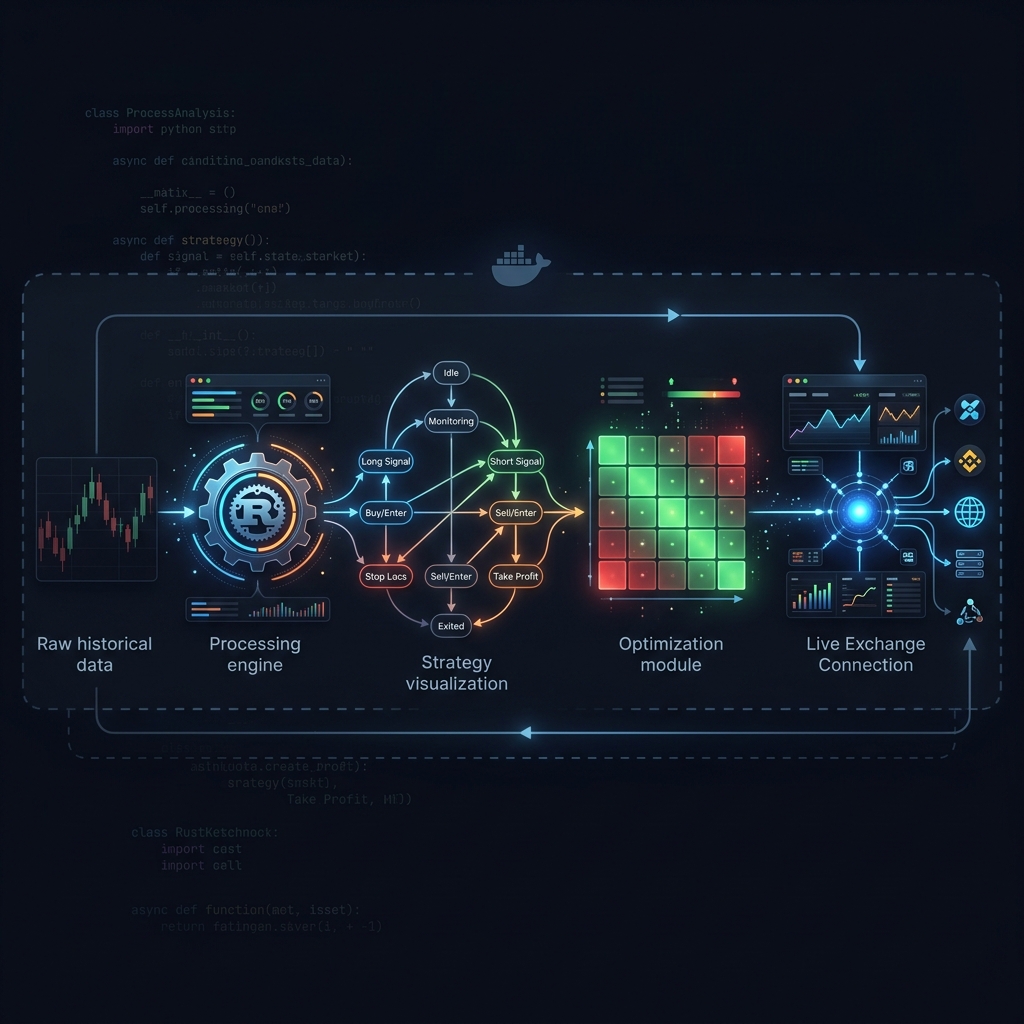

Most serious traders eventually come to a realization: candlesticks are merely a derivative of the actual market processes. The real picture is formed in the order book, the trade flow, and the shifting of liquidity. Orderflow analysis tools — DOM heatmaps, cluster charts (footprints), trade feeds — have traditionally been the privilege of paid platforms: Bookmap, ATAS, Quantower, Sierra Chart. Subscription prices start at $50/month and can easily exceed $200.
Flowsurface is a completely free, open-source alternative written in Rust. The project has already gained 1,500+ stars on GitHub, 289 forks, and is actively developed (10 releases, the latest being v0.8.8 from April 24, 2026).
Why Does a Trader Need Orderflow?

Classical technical analysis works with "ready-made" candles: open, close, high, and low prices over a period. But a candle with the same body can hide fundamentally different pictures:
- Candle in a thin market — volume is distributed evenly, no large players present.
- Candle in a thick market — aggressive buyers/sellers literally "chew through" the order book, leaving characteristic clusters in the footprint.
Orderflow lets you see:
- Where liquidity sits (bid and ask walls in the order book).
- Where it shifts (pull/stack — being removed or built up).
- Who dominates — aggressive buyers or sellers (by delta, imbalances, pace).
- Traps — false breakouts where spoofing hides behind the walls.
What Flowsurface Can Do
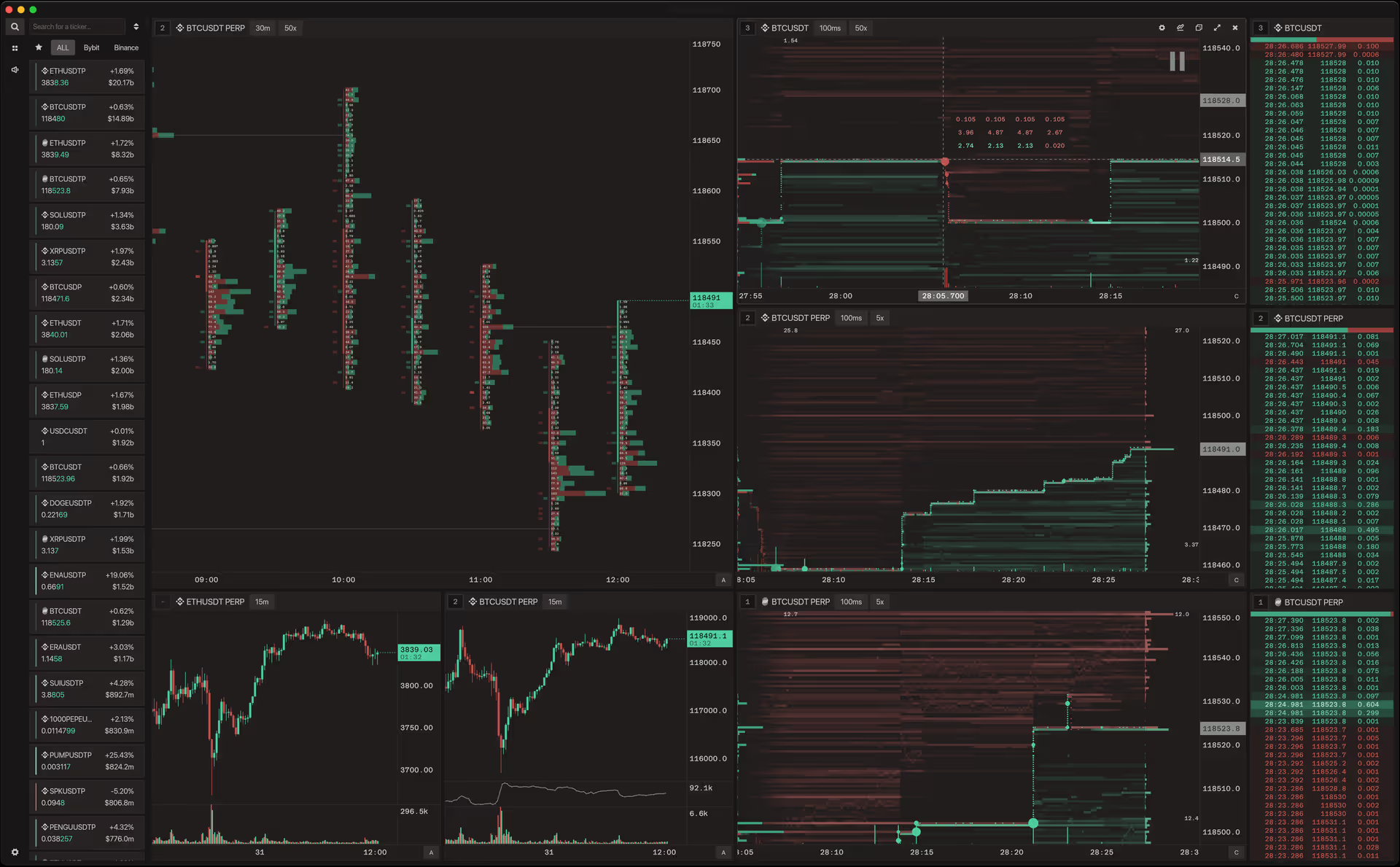
Heatmap DOM — Order Book Heat Map

The flagship feature and the application's calling card. Flowsurface visualizes historical market depth (L2 order book) in real time as a color map, where:
- X-axis — time.
- Y-axis — price.
- Color/brightness — order volume at a given price level.
You literally see liquidity appear, move, and disappear. Adaptive price grouping and Volume Profile overlay (fixed or visible range) are supported.
Footprint (Cluster Charts)
A mode that groups trades by time or tick count, overlaid on a candlestick chart. Available features:
- Imbalance — highlighting buy/sell imbalances at each price level.
- Naked POC — "naked" points of control that haven't yet been tested by price.
- Various clustering modes.
Depth Ladder
A classic DOM (Depth of Market) showing the current state of the L2 order book with recent trade volumes overlaid at each price level.
Time & Sales
A scrolling real-time trade feed — useful for tracking large executions and aggression patterns.
Candlestick Chart
Support for both standard time intervals and custom tick bars.
Multi-Pane Layouts
Multiple panes with different instruments/timeframes, linking for quick ticker switching, multi-monitor support.
Audio Alerts
Audio feedback from trade flow — useful for contextual perception of market pace without constantly watching the screen.
Supported Exchanges

- Binance (USDⓈ-M and COIN-M futures)
- Bybit (derivatives)
- Hyperliquid (DEX derivatives)
- OKX (perpetual futures)
- MEXC (futures)
Data comes directly from public REST APIs and exchange WebSockets — no routing through third-party servers.
Tech Stack

Flowsurface is a native desktop application, not an Electron wrapper:
- Language: Rust (99.3% of the codebase).
- GUI: Iced — a declarative GUI framework for Rust.
- License: GPL-3.0.
Rust provides:
- Low latency — critical during fast market movements.
- Minimal memory usage — Flowsurface is one of the lightest orderflow tools available.
- Cross-platform — macOS (Universal), Windows, Linux.
Historical Data
By default, Flowsurface captures and displays trades in real time via WebSocket. For Binance, historical trade loading is available:
- data.binance.vision — fast batch download of daily files.
- REST API (
/fapi/v1/aggTrades) — slower per-trade loading with rate limits.
Historical trade loading for Bybit and Hyperliquid is not yet supported due to lack of a suitable REST API. OKX — in development.
Installation
Pre-built Binaries
Executables for all platforms are available on the releases page.
Note (macOS): The application is not code-signed. On first launch, macOS will show a Gatekeeper warning. Go to System Settings → Privacy & Security and click "Open Anyway."
Building from Source
# Clone
git clone https://github.com/flowsurface-rs/flowsurface
cd flowsurface

# Build and run
cargo build --release
cargo run --release
Dependencies:
- Linux (Debian/Ubuntu):
sudo apt install build-essential pkg-config libasound2-dev - macOS:
xcode-select --install - Windows: no additional dependencies required.
Comparison with Paid Alternatives

| Feature | Flowsurface | Bookmap | ATAS | Quantower |
|---|---|---|---|---|
| Price | Free (GPL-3.0) | from $39/mo | from $69/mo | from $40/mo |
| Open Source | ✅ | ❌ | ❌ | ❌ |
| Heatmap DOM | ✅ | ✅ | ✅ | ✅ |
| Footprint | ✅ | Partial | ✅ | ✅ |
| Crypto Derivatives | ✅ (5 exchanges) | ✅ | ✅ | ✅ |
| Stocks/Futures (CME etc.) | ❌ | ✅ | ✅ | ✅ |
| Language | Rust (native) | Java | .NET | .NET |
| RAM Usage | Low | Medium–High | Medium | Medium |
Flowsurface doesn't cover traditional markets (stocks, CME futures) and focuses exclusively on crypto derivatives. That's its niche, and it does the job excellently — for free, fast, and transparently.
Who Is Flowsurface For
- Scalpers and intraday traders on crypto markets who read the order book and trade flow.
- Microstructure researchers who want to observe liquidity without a subscription fee.
- Developers who want to fork and extend the tool for their needs (GPL-3.0 allows it).
- Orderflow beginners who want to try heatmaps and footprints without financial risk.
Links
- 🌐 Website: flowsurface.com
- 💻 GitHub: flowsurface-rs/flowsurface
- 📦 Releases: Releases
- 💬 Discord: Join
Conclusion
Flowsurface is a rare example of an open-source project that genuinely competes with commercial products in a narrow professional niche. If you trade crypto derivatives and want to see the market "from the inside" — through the order book, liquidity, and trade flow — this is one of the best free ways to start.
And if you're a Rust developer — it's also an excellent example of native GUI application architecture using Iced with real WebSocket data streams.