Abonniere unseren Newsletter für exklusive KI-Trading-Einblicke, Marktanalysen und Plattform-Updates.
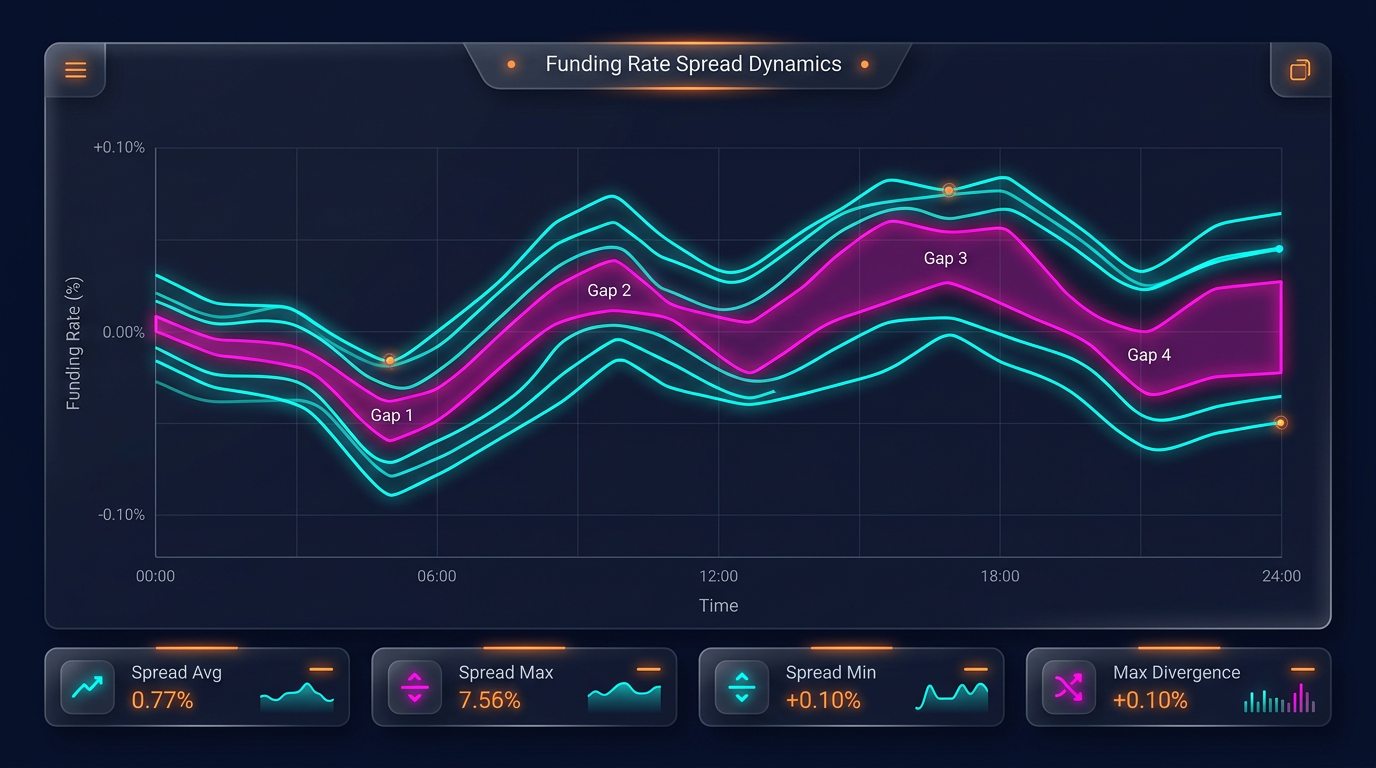
The funding rate on ETHUSDT is 0.01% on Binance and 0.035% on Bybit. The same coin, the same moment in time, but rates differ by 3.5x. Someone pays more, someone pays less. And someone profits from this difference.
Funding rate arbitrage is one of the few strategies in crypto that does not depend on market direction. You do not predict the price. You extract profit from the structural divergence of rates between venues.
Why Funding Rates Differ Across Exchanges
The funding rate is a mechanism that anchors the price of a perpetual futures contract to the spot price. Each exchange calculates it independently based on its own data:
Trader composition. Binance is dominated by retail traders who tend to go long. Bybit and OKX have more professional participants. Different long/short balance leads to different funding.
Calculation formula. Each exchange uses its own formula. Binance factors in the premium index and interest rate. Bybit and OKX do the same but with different weights and averaging periods.
Liquidity. On less liquid exchanges, the premium (difference between futures and spot) is more volatile, causing funding to fluctuate more widely.
Payment frequency. Most exchanges pay funding every 8 hours (00:00, 08:00, 16:00 UTC). But some (Bybit for certain pairs, dYdX) pay every hour, creating additional opportunities.
Typical Divergences
In a calm market, funding rates on major exchanges are close — the difference is 0.001-0.005%. But during periods of heightened volatility, divergences grow:
Market Phase
Binance
Bybit
OKX
dYdX
Spread
Calm
0.01%
0.012%
0.009%
0.01%
~0.003%
Bullish trend
0.03%
0.05%
0.025%
0.04%
~0.025%
Extreme bullish
0.1%
0.2%
0.08%
0.15%
~0.12%
Bearish trend
-0.02%
-0.01%
-0.025%
-0.015%
~0.015%
A spread of 0.025% per 8 hours is 0.075% per day. With a position size of 100K,thatis75/day or ~$2,250/month — without directional risk.
Basic Arbitrage Mechanics
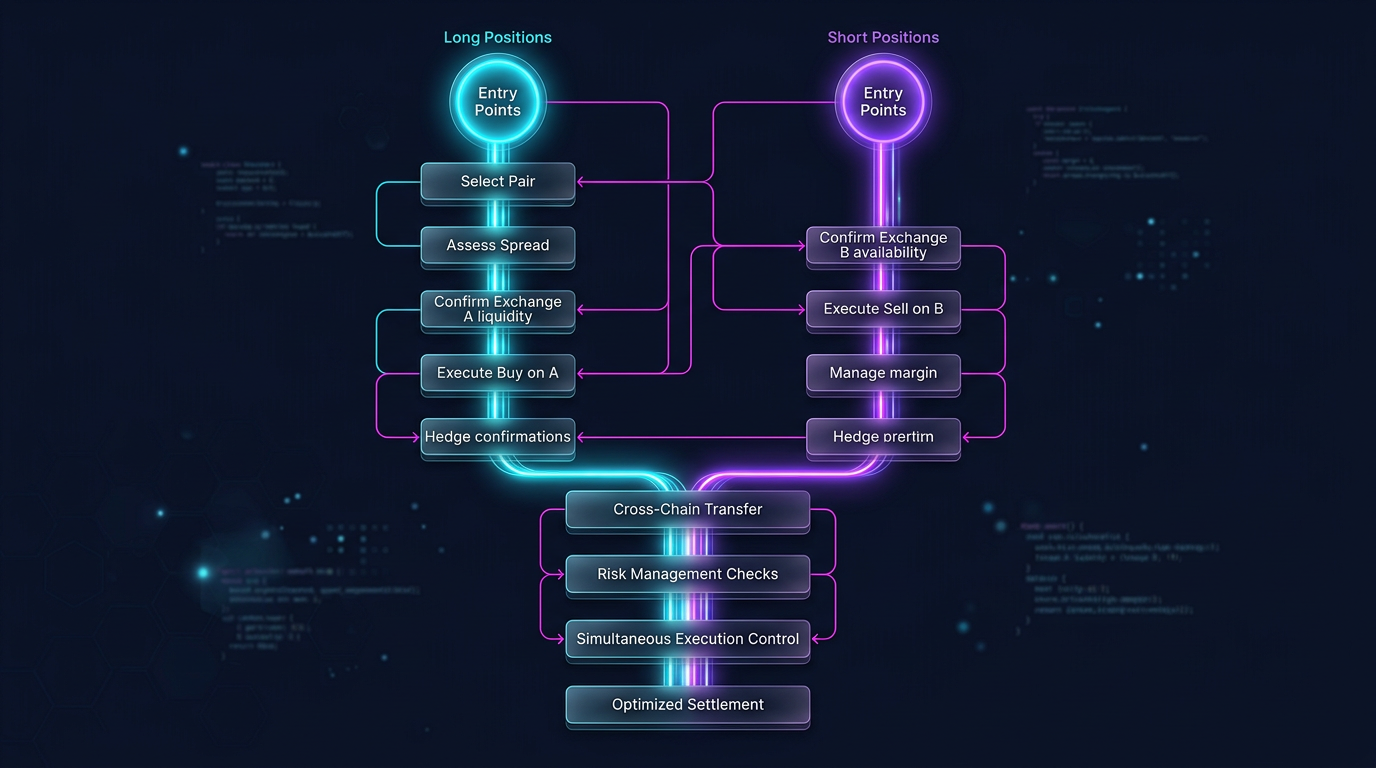
The idea is simple: open opposite positions on two exchanges so that you receive funding on one and pay less on the other.
Open a short on Bybit — receive 0.04% every 8 hours
Open a long on Binance — pay 0.01% every 8 hours
Positions are mirrored — price risk is neutral
Net profit: 0.04% - 0.01% = 0.03% per 8 hours
Per day (3 payments): 0.09%. Per month: ~2.7%. Without directional risk.
deffunding_arbitrage_pnl(
rate_short_exchange: float, # rate on the exchange where we short
rate_long_exchange: float, # rate on the exchange where we long
position_size: float, # position size in USD
payments_per_day: int = 3,
days: int = 30,
) -> float:
"""
PnL from funding rate arbitrage over a period.
With positive funding: short receives, long pays.
With negative funding: short pays, long receives.
"""
spread = rate_short_exchange - rate_long_exchange
daily_pnl = spread * payments_per_day * position_size
return daily_pnl * days
pnl = funding_arbitrage_pnl(0.0004, 0.0001, 100_000, days=30)
Risks and Pitfalls
The strategy looks like "free money." It is not. There are several serious risks.
1. Price Divergence Between Exchanges
Positions on different exchanges are not at the same price. The spread between Binance and Bybit is usually 0.01-0.05%, but during moments of high volatility it can reach 0.5-1%. If you do not open positions simultaneously, the divergence can exceed the funding profit.
Solution: simultaneous opening via API with minimal latency. Ideally — collocated servers near both exchanges.
2. Funding Rate Changes
You opened positions at a spread of 0.03%. An hour later the spread narrowed to 0.005% or reversed. Now you are paying on both exchanges.
Solution: real-time spread monitoring and automatic closing when the spread falls below a threshold.
defshould_close(
current_spread: float,
entry_spread: float,
min_spread: float = 0.0001, # 0.01%
trading_costs: float = 0.0005, # 0.05% for opening + closing) -> bool:
"""
Close the position if the spread has fallen below the threshold
or if the current spread does not cover trading costs.
"""return current_spread < min_spread or current_spread < trading_costs
3. Trading Commissions
Opening and closing positions on two exchanges means 4 orders. At a maker fee of 0.02% and taker fee of 0.05%:
Optimistic scenario (all maker): 4×0.02%=0.08%
Pessimistic scenario (all taker): 4×0.05%=0.20%
For commissions to break even, the position must be held long enough:
Breakeven time=Spread×Payments per dayTotal commissions
defbreakeven_days(
total_commissions_pct: float, # total commissions in %
spread: float, # funding rate spread
payments_per_day: int = 3,
) -> float:
daily_income = spread * payments_per_day
return total_commissions_pct / daily_income if daily_income > 0elsefloat('inf')
4. Margin Requirements
Positions on both exchanges require collateral. At 5x leverage on each exchange with a $100K position:
Binance: $20K collateral
Bybit: $20K collateral
Total locked: **40K∗∗fora100K position
Return on capital:
ROC=$40000$2700×100%=6.75% per month
At 10x leverage, collateral drops to $20K, ROC rises to 13.5%. But the risk of liquidation from price divergence also increases.
5. Liquidation Risk
If the asset price moves sharply, one of the positions generates an unrealized loss. On the exchange with the losing position, margin must be maintained. If margin is insufficient — liquidation. Meanwhile, the profit on the other exchange does not help — it is in a different account.
Solution:
Keep a margin reserve (at least 2x the minimum)
Set up margin level alerts
Automatic rebalancing: when an imbalance occurs — transfer funds between exchanges
Funding Rate Monitoring System
The first step toward arbitrage is data collection. You need to track funding rates across all exchanges of interest in real time.
import asyncio
import ccxt.pro as ccxt
from dataclasses import dataclass
from datetime import datetime
@dataclassclassFundingSnapshot:
exchange: str
symbol: str
rate: float
next_funding_time: datetime
timestamp: datetime
classFundingMonitor:
"""
Monitor funding rates across multiple exchanges.
"""def__init__(self, symbols: list[str], exchanges: list[str]):
self.symbols = symbols
self.exchanges = {
name: getattr(ccxt, name)() for name in exchanges
}
self.latest: dict[str, dict[str, FundingSnapshot]] = {}
asyncdeffetch_funding(self, exchange_name: str, exchange, symbol: str):
"""Fetch current funding rate from an exchange."""try:
funding = await exchange.fetch_funding_rate(symbol)
return FundingSnapshot(
exchange=exchange_name,
symbol=symbol,
rate=funding['fundingRate'],
next_funding_time=datetime.fromtimestamp(
funding['fundingTimestamp'] / 1000
),
timestamp=datetime.utcnow(),
)
except Exception as e:
print(f"Error fetching {exchange_name}{symbol}: {e}")
returnNoneasyncdefscan(self) -> list[dict]:
"""
Scan all exchanges and find arbitrage opportunities.
"""
tasks = []
for ex_name, ex inself.exchanges.items():
for symbol inself.symbols:
tasks.append(self.fetch_funding(ex_name, ex, symbol))
snapshots = await asyncio.gather(*tasks)
snapshots = [s for s in snapshots if s isnotNone]
by_symbol: dict[str, list[FundingSnapshot]] = {}
for s in snapshots:
by_symbol.setdefault(s.symbol, []).append(s)
opportunities = []
for symbol, rates in by_symbol.items():
rates.sort(key=lambda x: x.rate)
lowest = rates[0] # long here (pay less)
highest = rates[-1] # short here (receive more)
spread = highest.rate - lowest.rate
opportunities.append({
'symbol': symbol,
'long_exchange': lowest.exchange,
'long_rate': lowest.rate,
'short_exchange': highest.exchange,
'short_rate': highest.rate,
'spread': spread,
'annualized': spread * 3 * 365 * 100, # in % annualized
})
returnsorted(opportunities, key=lambda x: -x['spread'])
Instead of futures on two exchanges, you can use spot + futures on a single exchange:
Buy spot (no funding)
Short the perpetual futures (receive funding when the rate is positive)
Advantage: everything on one exchange, simpler margin management. Disadvantage: only works with positive funding (longs pay shorts), which is observed ~70% of the time during a bull market.
When monitoring 5+ exchanges simultaneously, you can find more favorable opportunities. Algorithm:
Collect funding rates from all exchanges
Find the pair with the maximum spread
Check liquidity and order book depth on both exchanges
If spread > threshold — open positions
Continuously rescan: if the best pair changes — rotate
deffind_best_pair(
rates: dict[str, float], # {"binance": 0.01, "bybit": 0.04, "okx": 0.02}
min_spread: float = 0.0002,
) -> tuple[str, str, float] | None:
"""
Find the exchange pair with the maximum funding rate spread.
Returns: (long_exchange, short_exchange, spread) or None.
"""
exchanges = list(rates.keys())
best = Nonefor i, ex_long inenumerate(exchanges):
for ex_short in exchanges[i+1:]:
if rates[ex_long] < rates[ex_short]:
spread = rates[ex_short] - rates[ex_long]
long_ex, short_ex = ex_long, ex_short
else:
spread = rates[ex_long] - rates[ex_short]
long_ex, short_ex = ex_short, ex_long
if spread >= min_spread:
if best isNoneor spread > best[2]:
best = (long_ex, short_ex, spread)
return best
Predicting the Funding Rate
The funding rate is calculated using a formula that includes the premium index — the difference between the futures price and the spot price. The premium updates more frequently than funding (every minute vs every 8 hours). This means you can predict the next funding rate minutes or hours before the payment.
defpredict_next_funding(
premium_index: float,
interest_rate: float = 0.0001, # 0.01% per 8h (standard)
clamp_range: float = 0.0005, # ±0.05%) -> float:
"""
Predict the next funding rate based on the current premium index.
Binance formula: FR = clamp(Premium - Interest, -0.05%, 0.05%) + Interest
"""
diff = premium_index - interest_rate
clamped = max(-clamp_range, min(clamp_range, diff))
return clamped + interest_rate
Knowing the predicted funding rate, you can open positions before the payment, when the spread has not yet attracted the attention of other arbitrageurs.
Infrastructure Requirements
For serious funding rate arbitrage, you need infrastructure:
Component
Minimum
Optimal
Server
Cloud VPS
Collocated near exchanges
Latency
< 500ms
< 50ms
API keys
2 exchanges
5+ exchanges
Capital per exchange
$10K each
$50K+ each
Monitoring
Logs + alerts
Dashboard + auto-rebalancing
Data
REST API polling
WebSocket streaming
Economics at Different Scales
Capital
Position (5x)
Spread 0.03%
Monthly PnL
ROC
$10K
$25K
0.03%
~$675
~6.75%
$50K
$125K
0.03%
~$3,375
~6.75%
$200K
$500K
0.03%
~$13,500
~6.75%
ROC does not depend on scale (given sufficient liquidity). But the absolute profit at $10K capital may not justify infrastructure costs and time.
Conclusion
Funding rate arbitrage is a structural, delta-neutral strategy. It does not require price prediction, but it requires:
Infrastructure — real-time monitoring of rates across multiple exchanges
Execution speed — simultaneous opening of positions across different venues
Risk management — controlling margin, price divergence, and spread changes
Capital — profit is proportional to position size
Funding rate spreads are not constant. They widen during periods of volatility and narrow during calm periods. The task is to automatically find and exploit divergences while they exist.
@article{soloviov2026fundingarbitrage,
  author = {Soloviov, Eugen},
  title = {Funding Rate Arbitrage Across Exchanges: How to Profit from Rate Differences},
  year = {2026},
  url = {https://marketmaker.cc/ru/blog/post/funding-rate-arbitrage-cross-exchange},
  description = {How funding rate arbitrage works across crypto exchanges, why rates differ on Binance, Bybit, OKX and dYdX, and how to build a monitoring and execution system.}
}