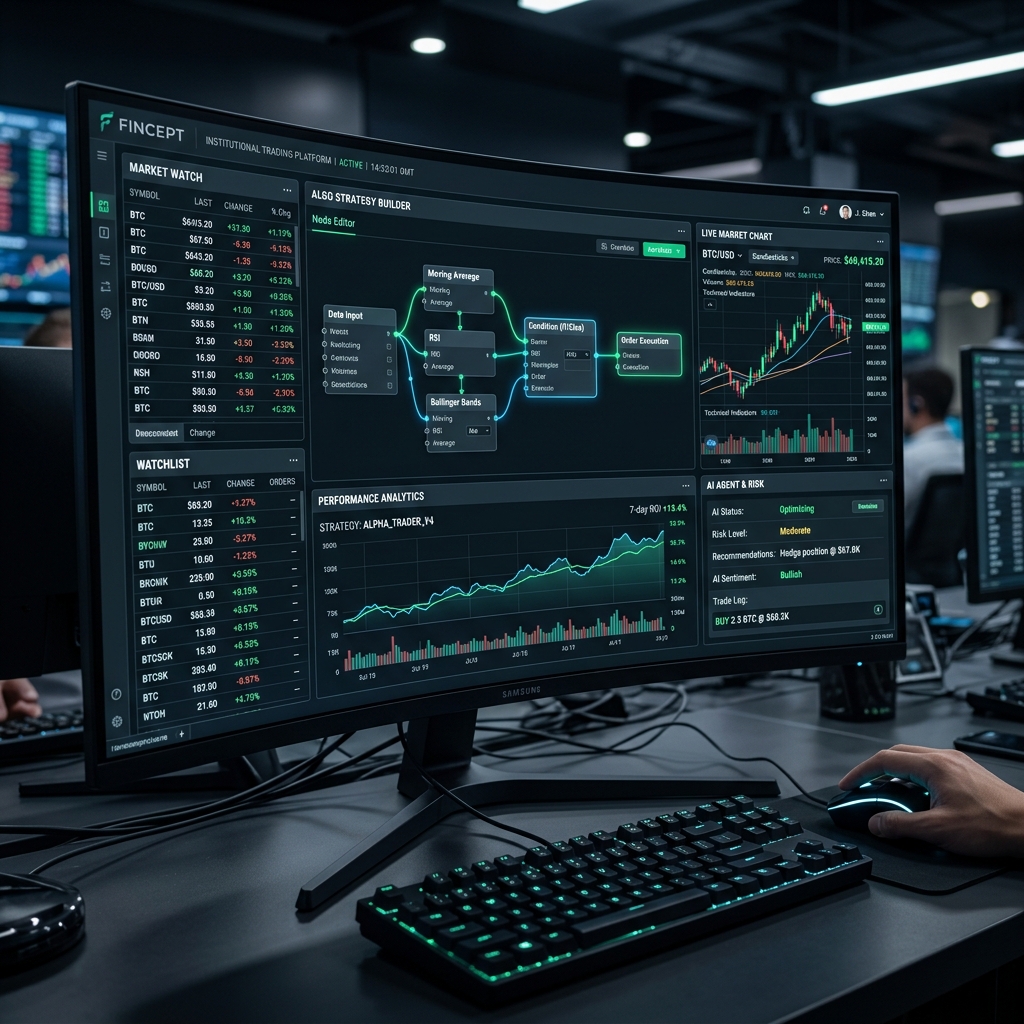

Most financial platforms fall into two camps: sluggish legacy systems from the 90s or Electron wrappers that devour RAM. Fincept Terminal is a third way: a native C++20 desktop with Python analytics and 37 built-in AI agents.
Fincept Terminal (AGPL-3.0) is an open-source project delivering institutional-grade functionality on your desktop. Let's break down the v4 architecture and, most importantly, the full catalog of agents and their skills.
Architecture
- Core: C++20. No Node.js, no browser engines, no JavaScript bundles.
- UI & Rendering: Qt 6.8.3. Hardware-accelerated graphics, instant responsiveness, cross-platform.
- Analytics Engine: Embedded Python 3.11 for data science (Pandas, NumPy, SciPy) without separate microservices.
The interface and streaming data processing run at C++ speed, while AI logic executes in an isolated Python environment.
AI Agents: Full Catalog
The most interesting part of Fincept is its agent system. The codebase reveals four tiers:
1. Investor Agents (TraderInvestorsAgent) — 11 Agents
Each agent implements a specific investment philosophy: its own system prompt, thresholds, toolset, and output signal format (InvestmentSignal).
| Agent | Philosophy | Key Skills | Tools |
|---|---|---|---|
| Warren Buffett | Value + economic moats | moat_analysis, owner_earnings, capital_allocation_review | yfinance, financial_datasets, duckduckgo, tavily |
| Benjamin Graham | Deep value, strict quantitative filters | deep_value_screening, margin_of_safety, defensive_investor | yfinance, financial_datasets |
| Peter Lynch | Growth at Reasonable Price (GARP), PEG | peg_analysis, lynch_classification, insider_signal_check | yfinance, financial_datasets, duckduckgo, tavily |
| Charlie Munger | Mental models, inversion, cognitive biases | mental_models_check, inversion_analysis, bias_detection, incentive_audit | yfinance, financial_datasets, duckduckgo, tavily |
| Seth Klarman | Risk-first value, distressed | downside_first_analysis, special_situations, capital_preservation | yfinance, financial_datasets |
| Howard Marks | Cycles, second-level thinking | cycle_positioning, second_level_thinking, credit_cycle_read | yfinance, financial_datasets, duckduckgo, tavily |
| Joel Greenblatt | Magic Formula (ROC + Earnings Yield) | magic_formula_ranking, roc_analysis, special_situations | yfinance, financial_datasets |
| David Einhorn | Catalyst-driven value, short selling | catalyst_identification, accounting_quality_check, long_short_analysis | yfinance, financial_datasets, duckduckgo, tavily |
| Bill Miller | Contrarian, FCF on tech | contrarian_value, platform_economics, free_cash_flow_focus | yfinance, financial_datasets, duckduckgo, tavily |
| Jean-Marie Eveillard | Global value, capital preservation | global_value, bubble_avoidance, currency_and_sovereign_risk | yfinance, financial_datasets |
| Marty Whitman | Distressed debt, credit analysis | distressed_debt_analysis, capital_structure_review, private_market_value | yfinance, financial_datasets |
Each agent generates a structured signal: bullish | neutral | bearish with a numeric confidence (0–1), scores on its own metrics, and textual reasoning. For example, the Buffett agent checks ROE ≥ 15% for 7 out of 10 years, D/E < 0.5, and calculates owner earnings with a 10% discount.
2. Economic Agents (EconomicAgents) — 6 Agents
Six economic schools, each with its own analytical framework. Designed for macroeconomic analysis, policy evaluation, and forecasting.
| Agent | School | Key Skills |
|---|---|---|
| Capitalism Analyst | Free market, supply-side | supply_side_analysis, market_mechanism_framing |
| Keynesian Analyst | Aggregate demand, fiscal stabilization | aggregate_demand_analysis, fiscal_policy_framing |
| Neoliberal Analyst | Deregulation, trade liberalization | deregulation_analysis, trade_liberalization_framing |
| Socialist Analyst | Inequality, redistribution | inequality_analysis, redistribution_framing |
| Mixed Economy Analyst | Pragmatic market-state balance | market_failure_analysis, pragmatic_policy_framing |
| Mercantilist Analyst | Strategic industries, trade balances | trade_balance_analysis, strategic_industry_framing |
All use OpenBB for macro data and search tools (DuckDuckGo, Tavily). Each agent is required to specify a falsification condition — the specific outcome under which it would revise its forecast.
3. Geopolitical Agents (GeopoliticsAgents) — 20 Agents
The largest module. Agents are divided into three series, each based on a specific book:
📖 Prisoners of Geography (Tim Marshall) — 10 agents:
Geographic determinism. Each agent specializes in a specific region: Russia (buffer zones, warm-water ports), China (Malacca Strait, island chains), USA (ocean barriers, Mississippi), Europe (fragmented terrain), Middle East (Strait of Hormuz, water scarcity), Africa (colonial borders, non-navigable rivers), India-Pakistan (Indus, Himalayas), Japan-Korea (island isolation vs peninsula vulnerability), Latin America (Andes, Amazon), Arctic (melting ice, new routes).
📖 World Order (Kissinger) — 5 agents:
Competing conceptions of world order: American (liberal internationalism), Chinese (tianxia, hierarchical harmony), European (Westphalian sovereignty), Islamic (ummah, sharia), Multipolar (BRICS, SCO, decline of unipolarity).
📖 The Grand Chessboard (Brzezinski) — 5 agents:
Eurasian geostrategy: Eurasian Balkans (Central Asia), Geopolitical Pivots (Ukraine, Turkey, Iran), Active Geostrategic Players (revisionists vs status quo), American Primacy (NATO, AUKUS, QUAD), Eurasian Heartland (Mackinder theory + BRI).
4. Operational Agents (Deep Agents) — 8 Subagents
Multi-agent system with an orchestrator. Operational task types: research, trading_strategy, portfolio_management, risk_assessment, general. For each task type, a team of subagents is automatically assembled:
| Subagent | Role |
|---|---|
| Research | Information gathering and synthesis from multiple angles |
| Data Analyst | Quantitative analysis, financial ratios, statistics |
| Trading | Trading strategies, technical setups, entries/exits |
| Risk Analyzer | VaR (historical, parametric, Monte Carlo), stress tests |
| Portfolio Optimizer | Markowitz optimization, factor tilts, rebalancing |
| Backtester | Historical simulation, walk-forward, overfitting protection |
| Reporter | Synthesizing results into a structured report |
| Macro Economist | Macroeconomics, central banks, yield curve, credit spreads |
5. Trading Agents (Agno Trading) — 5 Agents
A framework for live trading with five specialized agents:
- MarketAnalystAgent — fundamental and technical analysis.
- TradingStrategyAgent — generating trading strategies and setups.
- RiskManagerAgent — VaR calculation and drawdown limits.
- PortfolioManagerAgent — rebalancing and weight optimization.
- SentimentAnalystAgent — parsing news and social media.
Tools: Kraken API, yfinance, technical indicators, news sentiment.
6. Hedge Fund Agent (Renaissance Technologies)
A dedicated module replicating the organizational structure of Renaissance Technologies: investment committee, research team, Medallion Fund. Full hierarchy of personas and roles.
LLM Providers
Support for local LLMs (Ollama) alongside cloud providers: OpenAI, Anthropic, DeepSeek, OpenRouter. You can analyze proprietary data without sending it to third-party servers.
Visual Logic Editor (Node Editor)
A node editor for assembling analytical pipelines without code: data retrieval → filtering → AI analysis → order generation. The codebase includes ready-made node presets: agent_type = "economic", agent_type = "investor", agent_type = "hedge_fund".
Data Connectors (100+)
| Category | Sources |
|---|---|
| Traditional markets | Yahoo Finance, FRED, IMF, World Bank, DBnomics, BEA, Databento |
| Crypto | WebSocket to Kraken, HyperLiquid |
| Alternative data | Maritime tracking, satellite data, Adanos Market Sentiment |
| Asian markets | AkShare (Shanghai, Shenzhen, Hong Kong) |
| Prediction markets | Polymarket |
| Geopolitics | Integration with geopolitical agents |
Trading and QuantLib
Live trading through 16 brokers (Interactive Brokers, Alpaca, Zerodha, etc.). Built-in QuantLib Suite — 18 tools: derivatives pricing, VaR, Sharpe ratio, Markowitz portfolio optimization.
Comparison with Alternatives
| Feature | Fincept Terminal | Bloomberg Terminal | TradingView |
|---|---|---|---|
| Price | Free (AGPL-3.0) | ~$25,000/year | 60/month |
| AI Agents | 37+ built-in | None | None |
| Native code | C++20 | C++ | Web (JS) |
| Local LLMs | ✅ (Ollama) | ❌ | ❌ |
| Node Editor | ✅ | ❌ | Pine Script |
| Open Source | ✅ | ❌ | ❌ |
Links
- 💻 GitHub: Fincept-Corporation/FinceptTerminal
- 🌐 Website: fincept.in
- 📄 License: AGPL-3.0 (personal/academic), commercial license for business use
Conclusion
Fincept Terminal is a rare case where an open-source project delivers not just charts and indicators, but a full multi-agent infrastructure. The 37 agents aren't a marketing number: each one has a detailed system prompt, specific trigger thresholds, and a set of API tools. If you're looking for a native desktop platform that combines quantitative analytics with AI agents — this is one of the best open-source options available.