AI соода аналитикасы, рынок талдоолору жана платформа жаңылыктары үчүн биздин жаңылыктар бюллетенине жазылыңыз.
Hello! Today we'll dive into one of the most important topics for trading system developers — how WebSocket methods for getting orderbooks work in CCXT. If you've ever faced questions like "why is the method in the documentation but doesn't work in practice?" or "which method to choose for monitoring 100+ trading pairs?", this article is for you.
Introduction: Why This Matters
When working with CCXT for market data collection, many face critical questions:
Which WebSocket methods for orderbooks are actually supported on different exchanges?
How do methods differ in traffic volume and data structure?
Why can automated tests show "✓" while the method doesn't work in practice?
In this article — a detailed breakdown of popular methods, their features, and the real situation with 75+ exchanges.
Overview of Key Methods
Modern exchange APIs offer several ways to get orderbook data via WebSocket. Let's examine each of them:
1. watchOrderBook - Classic Approach
This is the main method for subscribing to orderbook updates for a single trading pair.
Key characteristics:
Purpose: Subscribe to orderbook updates for one pair
Connection type: Persistent WebSocket connection
Data: Full orderbook (usually 100–1000 levels per side)
Traffic: Medium to high, depends on update frequency and depth
Important note:
The script only checks for method presence in the JavaScript object, not actual support on the exchange side. So "✓" doesn't always mean functionality — as we saw with the Gate.io example.
Based on practical experience with CCXT, here are the main recommendations:
1. Don't Rely Only on Documentation
Always test methods on real data before implementing in production. Method presence in API doesn't guarantee functionality.
2. Choose Method for the Task
Bulk monitoring:watchBidsAsks
Detailed analysis:watchOrderBook
One-time requests:fetchOrderBookWs
3. Optimize Traffic
For monitoring large numbers of pairs, watchBidsAsks can be 1000x more efficient than watchOrderBookForSymbols.
4. Prepare for Failures
Implement robust retry logic and data quality monitoring.
5. Test at Production Loads
API behavior can differ dramatically under load vs test requests.
Future of WebSocket APIs for Orderbooks
The industry is moving toward more standardized approaches:
Method unification between exchanges
Improved documentation with real examples
More efficient data compression protocols
Better debugging tools and monitoring
Conclusion
WebSocket APIs for orderbooks are powerful tools but require deep understanding of each exchange's specifics. CCXT significantly simplifies the work by unifying interfaces, but reality is still more complex than documentation.
The key to success is testing, monitoring, and choosing the right methods for specific tasks. Remember: what works on one exchange might not work on another, even if the APIs look identical.
A successful trading system is not just correct algorithms, but also reliable data infrastructure. And CCXT WebSocket methods are an important part of this infrastructure.
What's your experience with exchange WebSocket APIs? Have you encountered unexpected issues? Share in the comments!




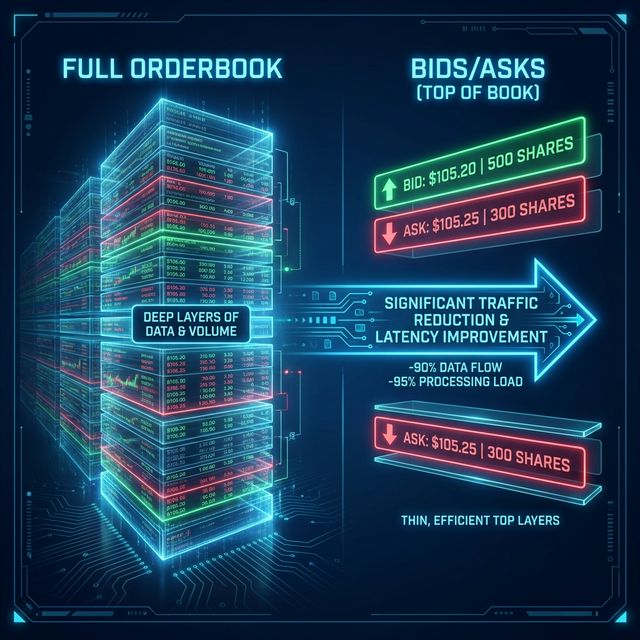 Visual comparison of data intensity between full orderbook and top-of-book (Bids/Asks) methods