Programmers don't get Nobel Prizes. But solving the Navier-Stokes problem gets you a million dollars from the Clay Institute—and it's the only millennium mathematics problem being simultaneously attacked by traditional mathematicians, AI researchers from DeepMind, and quantum engineers from IBM. In 2024, it was discovered that fluid dynamics equations are Turing-complete, meaning theoretically, your morning coffee cup could compute anything. Including Doom.
The Problem in 30 Seconds
In 1822, French engineer Claude-Louis Navier derived equations describing the motion of viscous fluids. Twenty-three years later, Briton George Stokes refined them to their modern form. The equations work beautifully—modern aerodynamics, weather forecasting, and movie special effects all depend on them. There's just one problem: nobody can prove these equations always have solutions. Or that they don't blow up to infinity in finite time.
Imagine a recursive function that modifies itself nonlinearly. You can't guarantee it won't enter an infinite loop or divide by zero. Now imagine infinite such functions, all interconnected, operating simultaneously at every point in three-dimensional space. That's the Navier-Stokes equations.
In two dimensions, the problem was solved in the 1960s by Soviet mathematician Olga Ladyzhenskaya. But in three dimensions, mathematics has been stuck for 200 years. The Clay Mathematics Institute offers a million dollars for proving existence and smoothness of solutions. Or for a counterexample showing solutions can "blow up."
Infinite Recursive Complexity: Visualizing the non-linear, self-modifying nature of fluid dynamics that makes analytical solutions notoriously difficult.
Why This Matters to Programmers
Every time you see realistic water in games, smoke simulation in Blender, or weather forecasts on your smartphone—behind it are numerical solutions to the Navier-Stokes equations. Half-Life 2 revolutionized gaming in 2004 precisely because of water physics based on these equations. Unity and Unreal Engine use simplified versions for real-time simulations. Pixar spent years developing algorithms for water in "Moana."
But there's a fundamental problem: we don't know if our numerical methods are correct. It's like using a sorting algorithm without proof of correctness—seems to work, but no guarantees. When Boeing designs a new wing, they spend millions on wind tunnel testing because CFD simulations can't be trusted 100%.
defnavier_stokes_step(u, v, p, dt, dx, dy, nu):
u_new = u - dt * (u * np.gradient(u, dx, axis=1) +
v * np.gradient(u, dy, axis=0))
u_new += nu * dt * laplacian(u, dx, dy)
p = solve_poisson(divergence(u_new, v_new), dx, dy)
u_final = u_new - dt * np.gradient(p, dx, axis=1)
return u_final, v_final, p
The problem lies in the advection line. The term u * np.gradient(u) means velocity affects itself. In turbulent regimes, this creates an energy cascade from large eddies to small ones, down to molecular scale. Full turbulence simulation requires resolution proportional to Re³, where Re is the Reynolds number. For an airplane, that's 10^18 grid points. Even all the world's supercomputers couldn't solve this.
DeepMind Finds New Singularities with AI
The biggest news of 2024: DeepMind's team used Physics-Informed Neural Networks to search for unstable singularities in simplified equation versions. Their computational accuracy is equivalent to "predicting Earth's diameter within a few centimeters."
AI discovered a pattern in parameter λ (blow-up rate) that human mathematicians missed over 200 years of research. This isn't a solution to the millennium problem, but demonstrates machine learning can find structures invisible to humans.
classNavierStokesPINN(nn.Module):
defforward(self, x, t):
u = self.net(torch.cat([x, t], dim=1))
return u
defphysics_loss(self, x, t):
u = self.forward(x, t)
u_t = autograd.grad(u, t)[0]
u_x = autograd.grad(u, x)[0]
u_xx = autograd.grad(u_x, x)[0]
residual = u_t + u * u_x - nu * u_xx
return torch.mean(residual**2)
Other teams achieved 1000x speedup compared to classical CFD. Stacked Deep Learning Models solve 512×512 grids in 7 milliseconds—faster than game frame rendering. This opens the path to real-time fluid simulations on regular GPUs.
Physics-Informed Neural Networks (PINNs): AI discovering hidden relationships and predicting unstable singularities in turbulent flows faster than classical CFD.
Quantum Computers Enter the Game
IBM and Georgia Tech demonstrated a hybrid quantum-classical algorithm for solving Navier-Stokes in 2024. The classical processor handles nonlinear advection, while the quantum computer solves the Poisson equation for pressure—the most computationally intensive part.
The HTree method efficiently reads quantum states even on noisy NISQ devices. While still a proof-of-concept for small grids, the potential is enormous. Quantum computers naturally work with superposition states, perfect for describing turbulence.
Mathematical Solution Attempts: 16 Revisions and Counting
Every year brings claims of solving the millennium problem. In December 2024, Anthony Jordon published the "Harmonic Resonance Field Model"—the mathematical community was skeptical. Xiangsheng Xu posted a preprint on ArXiv with a "positive answer" and updated it 16 times—a record for mathematical papers. Alexander Migdal proposed reducing three-dimensional Navier-Stokes to a one-dimensional system through "duality."
History teaches caution. In 2006, Penny Smith withdrew her "proof" after discovering an error. In 2014, Kazakhstani mathematician Otelbayev claimed a solution, but international review revealed fatal gaps.
Interestingly, most attempts focus on proving solution existence. But the correct answer might be a counterexample showing blow-up in finite time. This would be catastrophic for numerical methods but a breakthrough for mathematics.
Applications You Didn't Know About
Data Center Optimization. Google uses CFD to design cooling systems for server farms. Proper airflow distribution saves millions in electricity. Facebook developed its own CFD solver specifically for this task.
Future Medicine. Patient-specific CFD models blood flow in a specific patient's arteries based on MRI scans. Surgeons can predict surgery outcomes before the first incision. Startup SimVascular offers an open-source platform for such simulations.
Formula 1 and Aviation. Red Bull Racing uses a supercomputer with ANSYS Fluent for aerodynamic optimization. The mesh contains 100 million cells; one configuration calculation takes hours. FIA limits wind tunnel time, making CFD critically important.
Virtual Influencers and NFTs. The most unexpected application—dynamic fluid art in NFTs, where patterns are generated by solving Navier-Stokes in real-time. Virtual models on Instagram use CFD for realistic hair and clothing simulation.
Computational Fluid Dynamics in Action: From Formula 1 aerodynamics and global weather forecasting to modeling patient-specific arterial blood flow.
Turing-Completeness and Philosophical Implications
In mid-2024, mathematicians proved certain flow configurations can simulate any computable function. Navier-Stokes equations are Turing-complete. Theoretically, you could encode a program in initial flow conditions and "compute" the result through fluid evolution.
This sets fundamental limits on predictability. If a flow can simulate an arbitrary program, predicting its behavior is equivalent to solving the Halting Problem—a provably unsolvable task. Even perfect AI couldn't predict turbulence in all cases.
On the other hand, this opens the path to hydrodynamic computers. MIT researchers have already created logic gates based on liquid droplets. Future processors might compute not with electrons, but with vortices.
What's Next: Mathematicians vs Programmers
Two camps have formed in approaching the Navier-Stokes problem. Traditional mathematicians seek analytical proof using functional analysis and measure theory. Computational scientists attack the problem through machine learning, quantum algorithms, and computer-assisted proofs.
CFD startups aren't waiting for the millennium problem solution. ByteLAKE reduced industrial simulation time from hours to minutes. M-Star Simulations offers particle-based methods working on any hardware. Convergent Science released CONVERGE CFD v5 with autonomous mesh generation—no more months preparing models for calculation.
The open-source community isn't lagging. Professor Lorena Barba's CFDPython GitHub repository has thousands of stars. "12 Steps to Navier-Stokes" became the classic tutorial for programmers. OpenFOAM remains the industrial standard with 1.5 million lines of C++ code.
Epilogue: Coffee, Doom, and the Future of Computing
The Navier-Stokes problem remains the last bastion of classical physics resisting mathematical formalization. It's simultaneously a practical engineering problem worth trillions of dollars and a deep mathematical puzzle about the nature of infinity.
For programmers, it's a reminder that not all problems are solved by adding abstraction layers or increasing computational power. Some questions are fundamental. But breakthroughs are born precisely at the intersection of mathematics, physics, and computer science.
Perhaps the solution will come not from a lone genius with chalk and blackboard, but from a hybrid human-AI team combining mathematical intuition with computational power. Or maybe some junior developer will accidentally find a counterexample while optimizing water rendering in their indie game.
While we wait, remember: every time you stir your coffee, you're launching a computational process that could theoretically emulate any algorithm. Including Doom. We just don't know how to program in the language of turbulence yet.
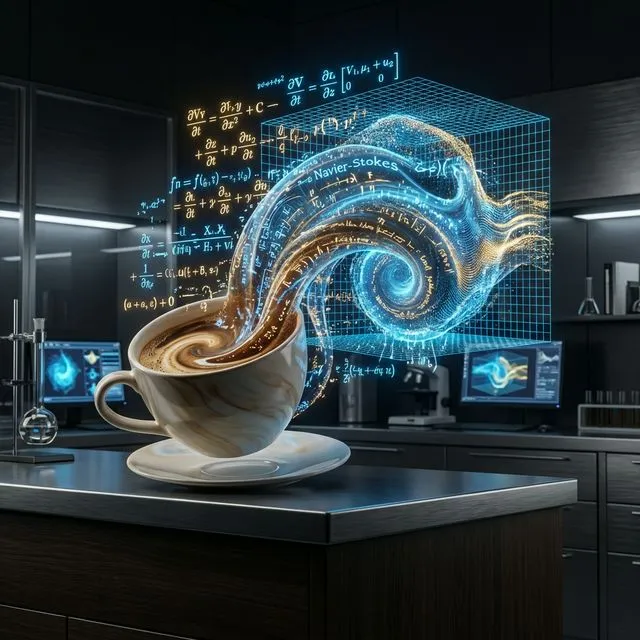

 Infinite Recursive Complexity: Visualizing the non-linear, self-modifying nature of fluid dynamics that makes analytical solutions notoriously difficult.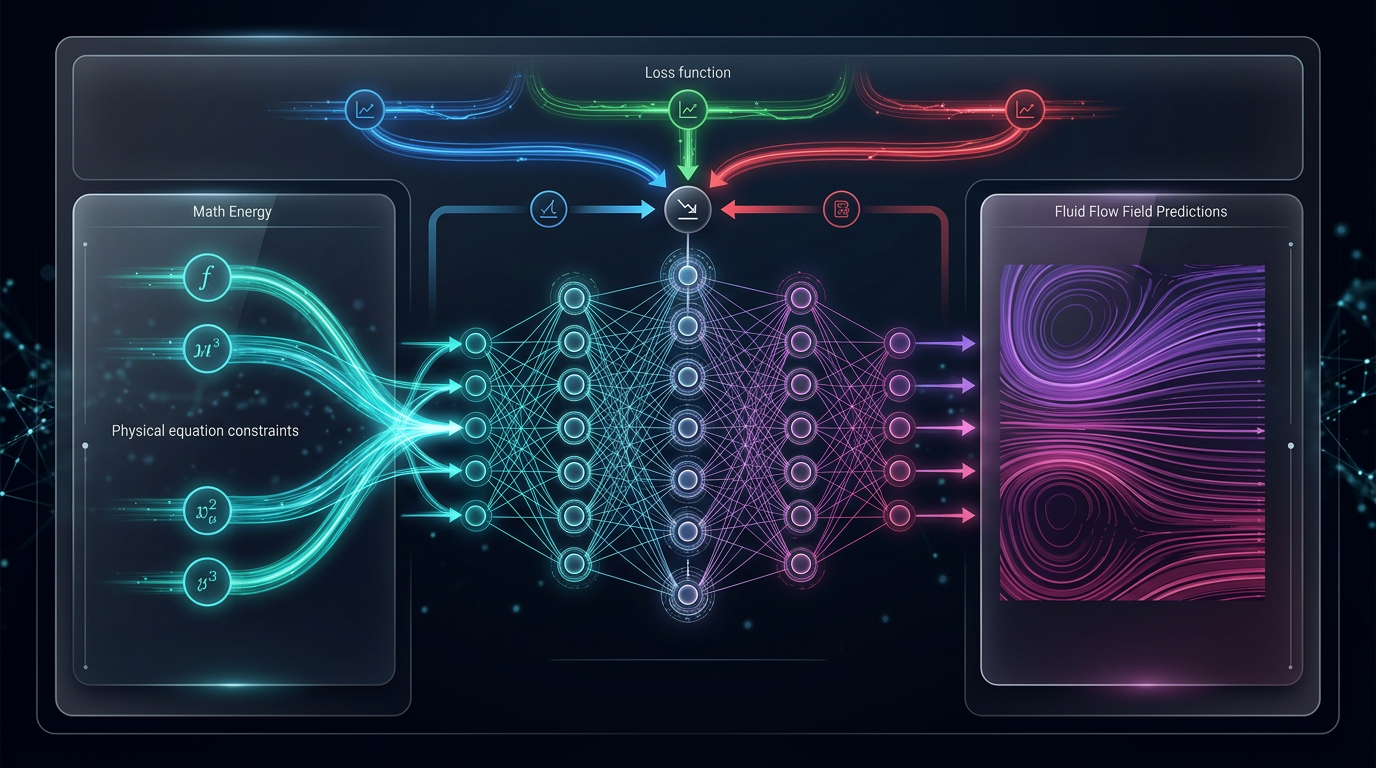
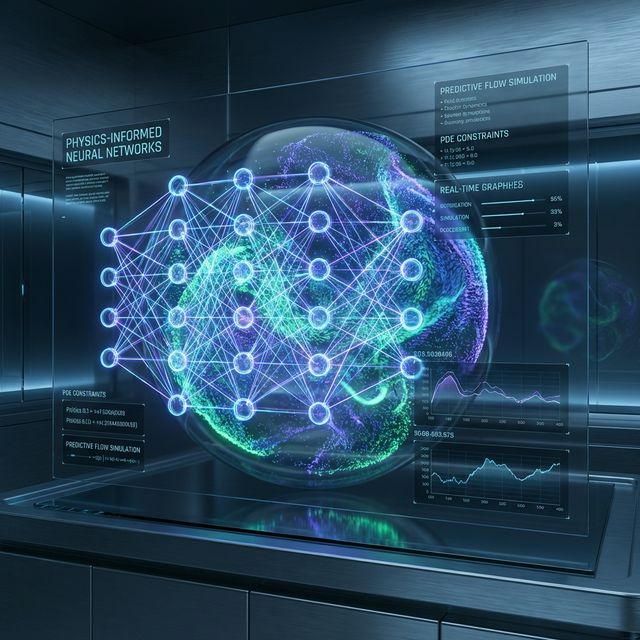 Physics-Informed Neural Networks (PINNs): AI discovering hidden relationships and predicting unstable singularities in turbulent flows faster than classical CFD.
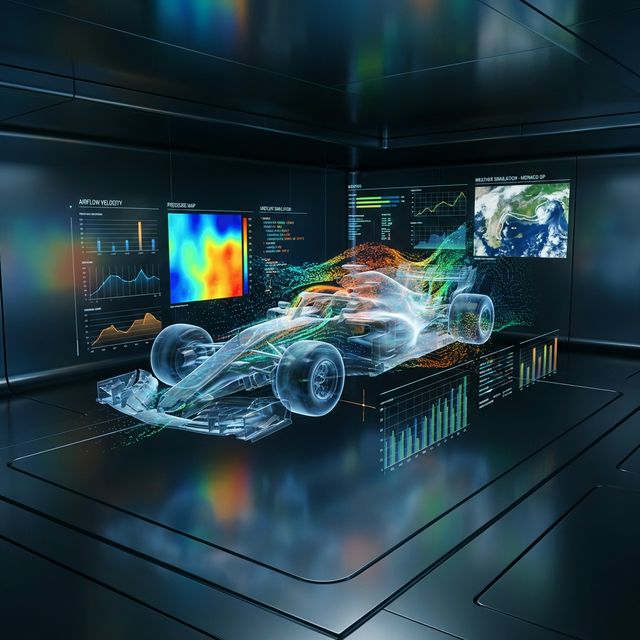 Computational Fluid Dynamics in Action: From Formula 1 aerodynamics and global weather forecasting to modeling patient-specific arterial blood flow.