Imagine: 1959, a young economics lecturer copies a colleague's trades and earns more than his university salary. Twenty years later, he loses everything, throws his fundamental analysis textbooks in the trash, and creates indicators now found in every trading terminal. This isn't a movie script — it's the real story of Bill Williams, the man who made Wall Street talk about chaos as order[1][6][11].
Visual representation of 'Trading Chaos': how apparent market disorder transforms into structured, tradable patterns through Williams' lens
From Church College to the Trading Floor
Born in 1932 to a working-class family, Bill could have become a priest — that's what his parents wanted. But instead of seminary, he chose New York University, earning two seemingly incompatible degrees: engineering physics and psychology[6][11]. This "cocktail" of hard science and human behavior became the foundation of his future system.
Williams' first trading steps were blind: he worked as a runner on the exchange, copied a friend's trades, and in the 1970s dared to become a professional trader. The result? A series of painful failures. "I lost money until I threw away all the textbooks and started listening to the market," he later recalled[13][17]. This was the turning point: instead of forecasts and charts, Williams began to study market psychology and nonlinear dynamics.
Five-Step Revolution: Key Inventions
1. Alligator — the Indicator that "Sleeps" and "Hunts"
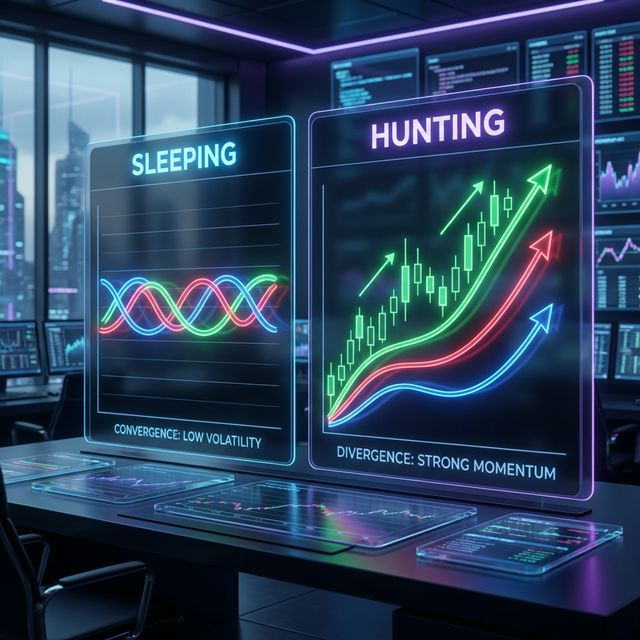
Three moving averages with predatory names (Jaw, Teeth, Lips) show market phases:
Sleep (lines intertwined) — flat market
Awakening (lines diverge) — trend begins
Hunting (clear direction) — time to open positions[4][18].
"When the Alligator is full, it closes its mouth — that's the signal to take profit," Williams explained in a 2008 interview[8].
The two primary states of the Alligator: 'Sleeping' during flat consolidation and 'Hunting' during strong trending momentum
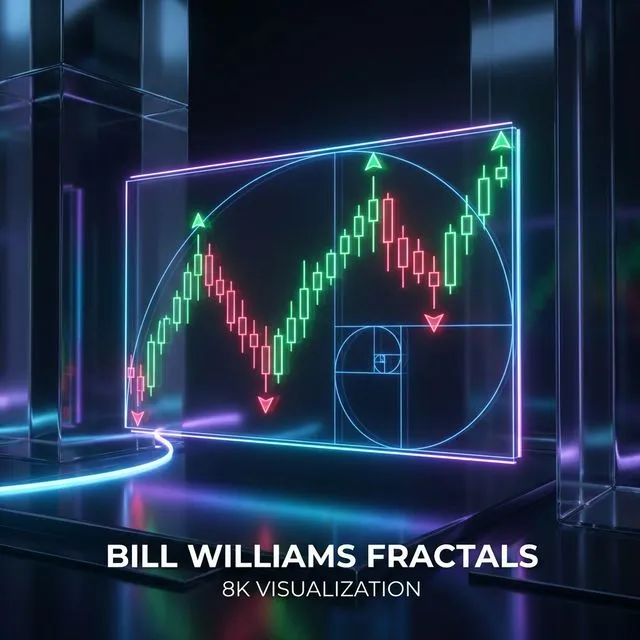
2. Fractals — the Market's "Fingerprints"
These arrows on the chart (at least 5 bars up/down) Williams called "reversal points." But he warned: "A fractal is not a signal, it's a beacon. Only trade when confirmed by the Alligator"[3][16].
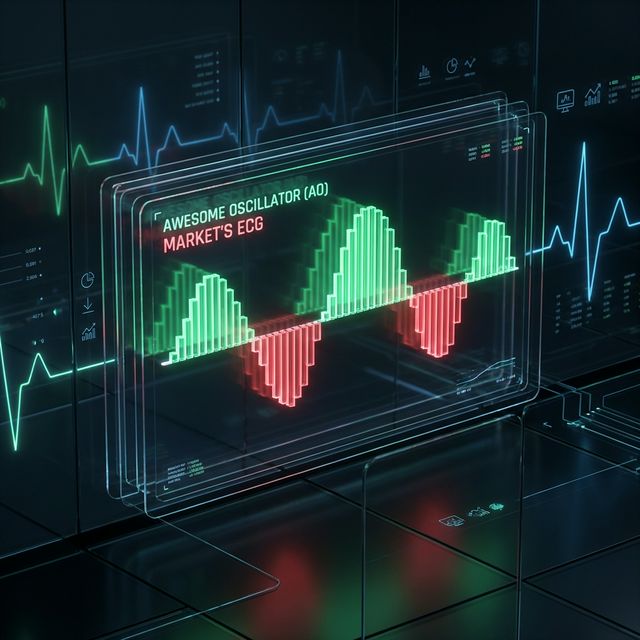
3. Awesome Oscillator (AO)
A histogram showing the "strength of the trend." Green bars above the previous — buy, red below — sell. "AO is the market's ECG," the creator joked[1][6].
Visualizing the Awesome Oscillator (AO) as a pulse-wave of the market's internal health and momentum
4. Market Facilitation Index (MFI)
A combination of volatility and volume. If price rises with increasing volume — the trend is strong. If volume falls — it's a "fake," reversal is near[1][18].
"The market is like an ocean: first you see the waves (fractals), then you feel the current (impulse), and real money is made by understanding the tides (balance)," the trader liked to say[9].
Philosophy: Why 95% of Traders Lose Money
Williams harshly criticized the traditional approach:
Fundamental analysis: "It's like trying to measure the ocean with a spoon — too many factors"
Technical analysis: "Linear models don't work in a nonlinear world"
Forecasting: "You can't predict the market, you must adapt to it"[2][6][16].
His main rules:
Trade the plan, not the forecast
Risk only 2% of your deposit per trade
"Don't teach a fish to swim" — follow the trend[9][19].
"Success is 80% psychology," Williams claimed. "Fear and greed are the worst advisors. You must become an 'observer' who sees the market without emotion"[6][9].
Profitunity School: A Family Business with 25,000 Graduates
In 1984, Williams founded a training center later headed by his daughter Justine. For $6,000, they taught:
How to recognize "chaotic patterns"
How to create "market maps"
How to manage risk through position sizing[14][17].
"We don't give you a fish — we teach you to catch it in any weather," said the founder. Among the students were hedge fund and central bank managers[11][14].
"It's not the Holy Grail," Williams retorted. "But for those ready to think nonlinearly, it's the key to understanding market logic"[8][11].
Legacy: From Charity to Memes
50% of profits from trading Williams donated to orphanages and environmental projects[5][17]
Indicators became standard in MetaTrader 4/5[6][16]
Memes about the "sleeping alligator" circulate in trading chats[4][8].
Bill Williams died in 2019, but his ideas are more alive than ever. As he said: "Chaos is order we don't yet understand. Learn to see structure in apparent disorder — and the market will become your ally"[9][11].
Citation
@article{williams2025biography,
  author = {Williams, Bill},
  title = {Bill Williams: How a Maverick with a Psychology Degree Changed Trading Forever},
  year = {2025},
  url = {https://marketmaker.cc/en/blog/post/bill-williams},
  version = {0.1.0},
  description = {Biography, philosophy, and inventions of Bill Williams — from engineering psychology to indicators that changed the market.}
}

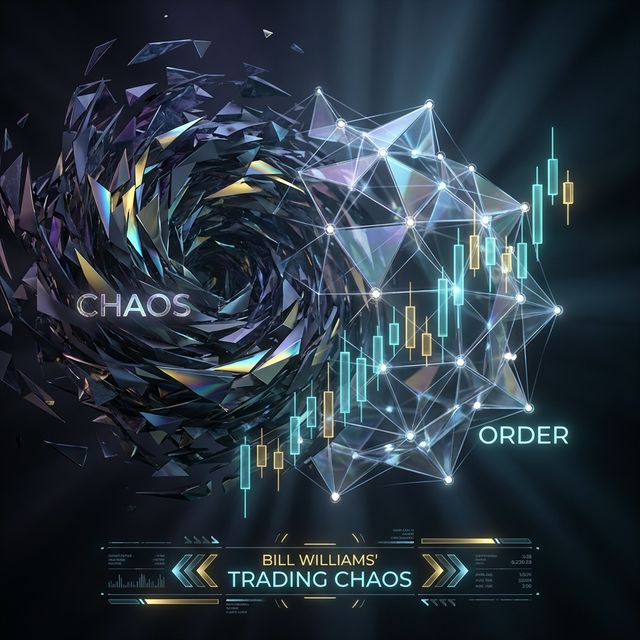 Visual representation of 'Trading Chaos': how apparent market disorder transforms into structured, tradable patterns through Williams' lens
 The two primary states of the Alligator: 'Sleeping' during flat consolidation and 'Hunting' during strong trending momentum
 Visualizing the Awesome Oscillator (AO) as a pulse-wave of the market's internal health and momentum