Kimchi Premium: How Arbitrage Works on Korean Crypto Exchanges
If you've ever seen the same Bitcoin trading at $3,000 more simply because the buyer is in Seoul rather than New York, you've witnessed the kimchi premium. It's one of the most remarkable market phenomena in the crypto industry: an entire country of 52 million people, nearly half of whom trade cryptocurrency, lives in its own pricing reality. Korean exchanges aren't just trading venues — they're a parallel financial universe with its own gravity, where prices are pulled upward by the efforts of millions of retail traders locked inside regulatory walls.
In this article, we'll break down how the kimchi premium works, why it exists, how people profit from it, and — the juiciest part — how to automate listing alpha on Korean exchanges. There will be plenty of specifics: APIs, WebSocket formats, on-chain monitoring, listing detection pipelines. Get comfortable and stock up on kimchi.
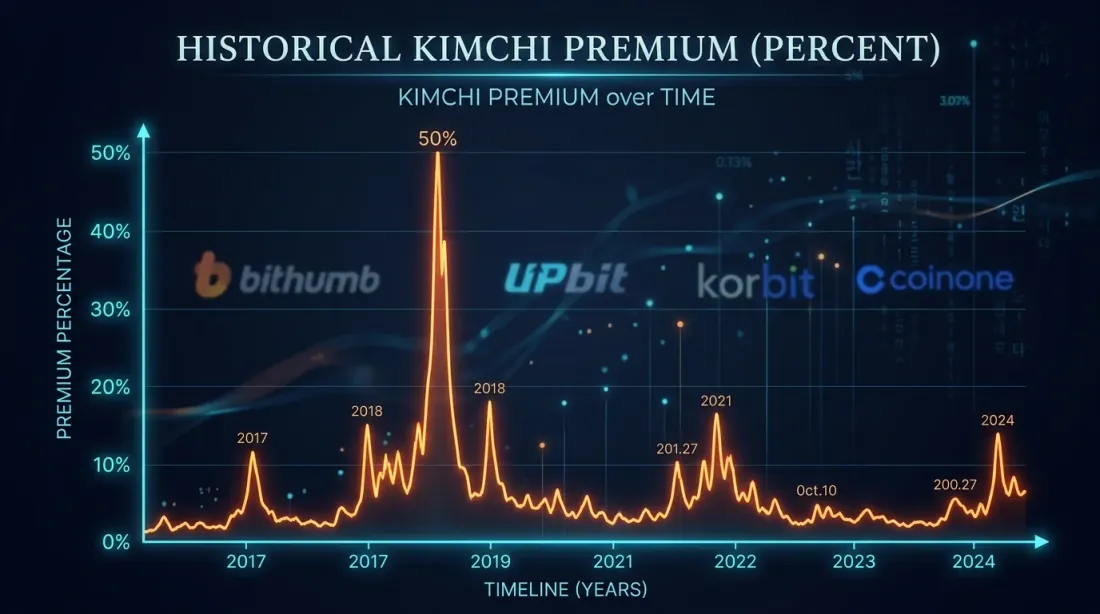 Kimchi premium dynamics from 2017 to 2026: from the insane 50%+ to today's 1-2% on quiet days. But the distribution's fat tails remain very much alive.
What Is the Kimchi Premium and Why Does It Exist
Definition and History
Kimchi premium (김치 프리미엄) is the systematic markup on cryptocurrencies on South Korean exchanges compared to global platforms. The name, obviously, refers to the national dish. Less obviously, why this phenomenon persists over time.
The kimchi premium first made headlines in 2017, when BTC on Bithumb was 30-50% more expensive than on Coinbase. In January 2018, at the peak of the crypto frenzy, the premium reached 54.48% — Bitcoin was trading at 17,000. For context: this wasn't a marginal anomaly — Korean exchanges were handling up to 30% of global crypto trading volume at the time.
Why It Exists: Five Structural Reasons
1. 25 million retail investors. According to the Financial Services Commission (FSC), by the end of 2025 South Korea had over 25 million registered accounts on crypto exchanges. The country's population is 52 million. This means nearly every other adult Korean trades crypto. For comparison: crypto trading penetration in the US is about 15%, in the EU about 10%. Korea is a country where taxi drivers discuss altcoins and grandmothers buy XRP.
2. Capital controls (Foreign Exchange Transaction Act). Korean citizens are limited to transferring up to $50,000 per year abroad without special permission. This creates an artificial barrier to arbitrage: even if you see that BTC on Upbit costs more than on Binance, you can't simply buy on Binance and sell on Upbit because getting fiat into a Korean exchange from outside is virtually impossible. Korean exchanges only work with bank accounts of Korean residents (Real-Name Verification system through K-bank, Shinhan, and others). This isn't a technical limitation — it's a legal wall.
3. No derivatives on Korean exchanges. The FSC has banned margin trading and futures on local platforms. No shorts — no selling pressure — no mechanism to correct inflated prices. On Binance or Bybit, when a price shoots up, shorters immediately push it back down. No such mechanism exists on Upbit. This is a market that can only move in one direction when the crowd decides to buy.
4. Regulatory isolation. Until 2024, foreign exchanges were formally unable to operate in Korea. The VASP (Virtual Asset Service Provider) Act of 2021 and the Travel Rule from 2022 further isolated the market. Withdrawing crypto from Korean exchanges to foreign ones is also difficult: KYC verification of the recipient is required, and some exchanges simply don't allow withdrawals to addresses not linked to verified accounts.
5. Cultural factor: "투기열풍" (speculative frenzy). South Korea is a country with fierce competition in everything, from education (수능 — the national exam) to the job market. Cryptocurrencies became a social elevator for young people who can't afford real estate in Seoul (average apartment price — 12x annual income). When the market rises, FOMO drives the premium into double digits.
Calculation Formula
The kimchi premium is calculated simply:
where is the price on the Korean exchange in won, is the USD/KRW exchange rate, and is the price on the reference exchange (usually Binance) in dollars.
An important nuance: the USD/KRW rate also has its own "spread." The bank rate, the Tether rate (USDT/KRW on Upbit), and the Forex market rate are three different numbers. Professional arbitrageurs use the USDT/KRW rate as a more accurate proxy for the real "crypto exchange rate" of the won.
Current State: 2025-2026
The Premium Has Shrunk, but It's Not Dead
If in 2017-2018 the kimchi premium was like an open money faucet, by 2025-2026 the situation has changed dramatically. In "calm" periods, the premium fluctuates in the 1-2% range, barely covering fees and spreads. Reasons for the compression:
- Increased transfer limits (up to $50,000/year);
- Emergence of OTC channels for large amounts;
- Growing competition among Korean exchanges (Upbit, Bithumb, Coinone, Korbit);
- Faster blockchains for asset transfers (Solana, Tron — withdrawals in minutes, not hours).
But the fat tails remain. During high volatility, the premium spikes:
| Event | Date | Premium |
|---|---|---|
| FTX collapse | November 2022 | -4.5% (inverted!) |
| BTC ETF approval | January 2024 | +8% |
| Trump pump | November 2024 | +11.5% |
| Political crisis (martial law) | December 2024 | +12%+ |
| CRV on Bithumb (panic) | 2025 | +600% (!!) |
The last case deserves special commentary: CRV (Curve) was trading on Bithumb at a 600x markup due to a liquidation cascade and panic. This isn't a typical kimchi premium — it's more of a Black Swan in an isolated order book. But it's precisely these events that make monitoring the Korean market a profitable endeavor.
Market Structure
The Korean crypto market is essentially a duopoly:
- Upbit: 80%+ of volume, partnership with K-bank, lists 200+ pairs, daily volume $3-8B
- Bithumb: 10-15% of volume, partnership with NH Bank, lists 150+ pairs
- Coinone: 3-5%, niche platform
- Korbit: <2%, mainly institutional clients
Upbit isn't just an exchange. It's the market maker for all of Korea. When Upbit lists a token, it's not just an announcement — it's an event that can create (or destroy) hundreds of millions of dollars in market capitalization within minutes.
Listing Alpha: The Most Profitable Edge
Upbit Listing = IPO-Level Event
This is arguably the most powerful edge in the Korean crypto market. An academic study by Park & Lee (2024) analyzed 105 Upbit listings from 2020-2023 and found:
- Average expected return: 51.9% at announcement, 108.9% in the first hour of trading
- Individual tokens: 800%+ intraday gains
- Median reaction time: 2-5 minutes from announcement to the first wave peak
Why are returns so extreme? Because 25 million retail investors, armed with mobile apps, simultaneously hit "Buy" when they see a new listing. And there are no shorts. At all. It's like an IPO in a world where short selling doesn't exist.
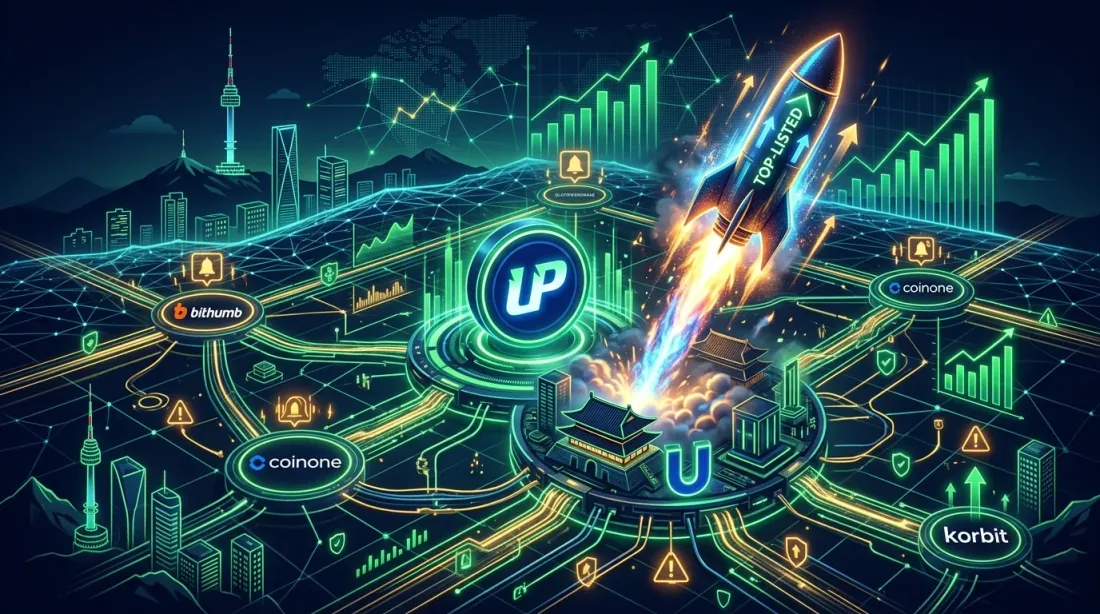 Distribution of returns from new token listings on Upbit: median — 51.9%, but the right tail extends to 800%+. Negative returns happen, but rarely.
Two Exploitation Strategies
Strategy 1: Directional. The idea: detect the Upbit listing announcement → immediately buy the token on Binance/OKX/Bybit → wait for 25 million Koreans to push the price up → sell. Key metric: detection speed. If you learned about the listing within 10 seconds — you made money. Within 5 minutes — you're already buying at the top.
Strategy 2: Spot-Perp arbitrage. The idea: buy the token on spot (Binance) + simultaneously open a short on perps (Binance/Bybit). You earn not from the directional move, but from basis widening and the funding rate, which spikes after a listing (long pressure on the Korean market translates into elevated demand on global platforms). Less risky, but returns are more modest — 5-20% per event.
Listing Detection: DataMaxi+ and WebSocket
Detection speed is the difference between a 50% profit and a 50% loss. Here's how the pipeline works:
DataMaxi+ API — a specialized data provider for the Korean market. Offers:
- WebSocket subscription for exchange announcements (announcement feed)
- Sub-second latency listing detection
- Historical listing data for backtesting
Connection example:
import websockets
import json

async def listen_listings():
    uri = "wss://api.datamaxi.com/ws/v1/announcements"
    async with websockets.connect(uri, extra_headers={
        "X-API-KEY": "your_api_key"
    }) as ws:
        await ws.send(json.dumps({
            "method": "SUBSCRIBE",
            "params": ["upbit.listing", "bithumb.listing"]
        }))
        async for msg in ws:
            data = json.loads(msg)
            if data["type"] == "NEW_LISTING":
                token = data["symbol"]
                exchange = data["exchange"]
                timestamp = data["timestamp"]
                await execute_listing_trade(token, exchange, timestamp)
Wallet Status API. Upbit provides an endpoint to check deposit/withdrawal status for each token. If the status changes from "unavailable" to "available" — it's a signal that a listing is imminent:
import httpx

async def check_wallet_status():
    url = "https://api.upbit.com/v1/status/wallet"
    headers = {"Authorization": f"Bearer {generate_jwt()}"}
    resp = await httpx.AsyncClient().get(url, headers=headers)
    for coin in resp.json():
        if coin["wallet_state"] == "working" and coin["currency"] not in known_coins:
            alert(f"New wallet active: {coin['currency']}")
On-Chain Monitoring of Exchange Wallets
The Idea
Before Upbit or Bithumb lists a token, they must prepare infrastructure: create hot wallets, conduct test transfers, receive tokens from the project. All of this happens on-chain and is potentially visible to an observer. If you notice that a token that was never traded on the exchange has arrived at a known Upbit hot wallet — that's a pre-listing signal.
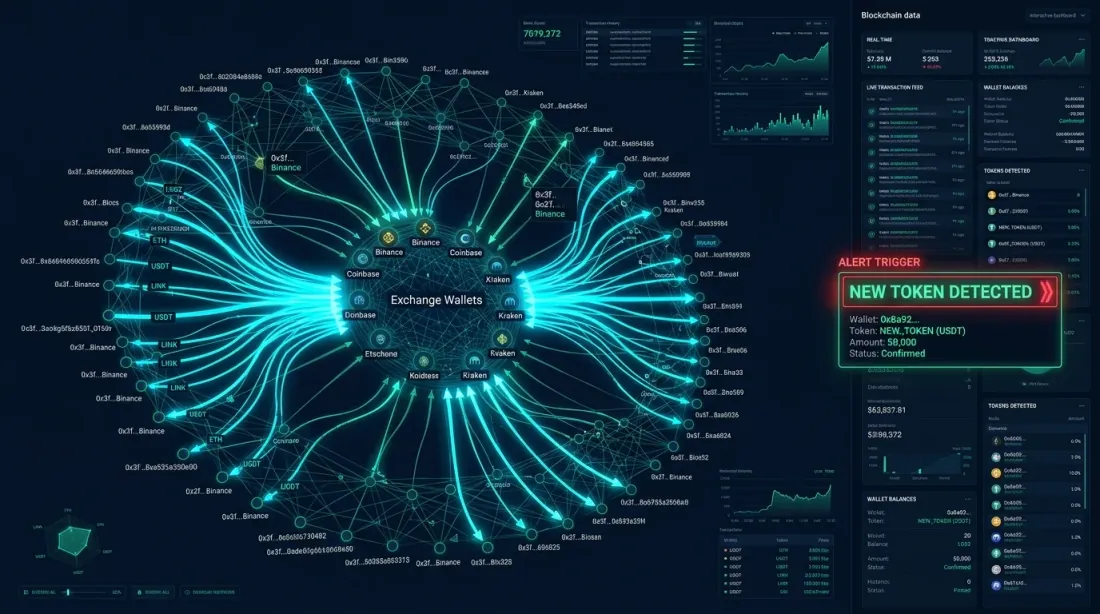 On-chain monitoring pipeline: collecting exchange addresses from public sources, subscribing to transfer events, cross-referencing with current listings, generating trade signals.
Address Sources
| Source | What It Provides | Link |
|---|---|---|
| Arkham Intelligence | Exchange address clustering, real-time alerts | intel.arkm.com |
| CoinCarp | Public exchange wallet addresses | coincarp.com/exchanges |
| Etherscan Labels | Address tags on Ethereum | etherscan.io/labelcloud |
| Solscan | Address tags on Solana | solscan.io |
| Nansen | Addresses + flow analytics (paid) | nansen.ai |
| Chainalysis | Institutional grade (very paid) | chainalysis.com |
Arkham Intelligence deserves a separate mention. Their system allows you to subscribe to push notifications for fund movements to/from specific addresses. For our task — an ideal tool.
What Exactly to Monitor
1. New tokens on known hot wallets. If you know Upbit's Ethereum hot wallet (and Arkham knows it), and an ERC-20 token that's not on Upbit's listings arrives at that address — that's a signal. Signal strength depends on volume: a test transfer of 500,000 transfer — strong signal.
2. Creation of new wallets. Exchanges sometimes create new wallets for a new blockchain or token. If Upbit deploys a new wallet on Sui or Aptos, which it hadn't supported before, a listing of tokens from that ecosystem is likely.
3. Transfers from project treasury. Some projects transfer tokens directly to exchange wallets before a listing. Monitoring treasury addresses of known projects can give lead time of hours or even days.
Automation Pipeline
The full pipeline looks like this:
1. COLLECT: Gather and maintain a database of Upbit/Bithumb addresses
   ├── Arkham Intelligence API → hot/cold wallets
   ├── CoinCarp scraping → public addresses
   └── Manual reverse-engineering → transfer pattern analysis

2. SUBSCRIBE: Subscribe to on-chain events
   ├── Ethereum: Alchemy/Infura WebSocket → Transfer events
   ├── Solana: Helius/Triton WebSocket → Token transfers
   ├── Tron: TronGrid → TRC-20 transfers
   └── Cosmos chains: LCD endpoints → IBC transfers

3. FILTER: Filter out noise
   ├── Exclude tokens already listed on the exchange
   ├── Amount threshold: > $10,000
   └── Cross-reference with announcement feed (DataMaxi+)

4. SCORE: Assess listing probability
   ├── Token rank (CoinGecko/CoinMarketCap)
   ├── Already listed on other Korean exchanges?
   ├── Volume source wallet (project treasury vs. random)
   └── Historical pattern matching

5. EXECUTE: When score > threshold
   ├── Buy on Binance/OKX (spot)
   ├── Optional: short perp for hedge
   └── Set take-profit / stop-loss
Python filter implementation example:
from dataclasses import dataclass
from datetime import datetime

@dataclass
class OnChainSignal:
    token: str
    chain: str
    exchange: str
    amount_usd: float
    from_address: str
    to_address: str
    timestamp: datetime
    tx_hash: str

class ListingDetector:
    def __init__(self, listed_tokens: set, exchange_wallets: dict):
        self.listed_tokens = listed_tokens   # {"BTC", "ETH", "XRP", ...}
        self.exchange_wallets = exchange_wallets  # {"0x...": "upbit_hot_1", ...}
        self.signal_history = []

    def process_transfer(self, signal: OnChainSignal) -> float:
        """Returns a score from 0 to 1 — listing probability."""
        if signal.token in self.listed_tokens:
            return 0.0

        score = 0.0

        if signal.amount_usd > 500_000:
            score += 0.4
        elif signal.amount_usd > 50_000:
            score += 0.2
        elif signal.amount_usd > 10_000:
            score += 0.1

        if self.is_project_treasury(signal.from_address):
            score += 0.3

        recent_same = [s for s in self.signal_history
                       if s.token == signal.token
                       and (signal.timestamp - s.timestamp).hours < 24]
        if len(recent_same) >= 2:
            score += 0.2

        if self.get_token_rank(signal.token) <= 200:
            score += 0.1

        self.signal_history.append(signal)
        return min(score, 1.0)
False Positives and Pitfalls
On-chain monitoring is no magic wand. The main issues:
- Exchanges use proxy wallets. Upbit doesn't always receive tokens directly to its main hot wallet. Intermediate addresses are often used, which are then aggregated.
- Test transfers. An exchange may receive a token for technical testing but never actually list it.
- Timing gap. Between wallet preparation and the actual listing, hours to weeks can pass. Your capital will be frozen in a position the entire time.
- Adversarial environment. You're not the only one monitoring these addresses. Arkham Intelligence is available to everyone. The more people watching the same signal, the less valuable it becomes.
Microstructure: Upbit vs Bithumb in Detail
Upbit API
Upbit provides one of the simplest APIs in the industry. This is both a plus and a minus.
REST API:
- Orderbook:
GET /v1/orderbook?markets=KRW-BTC— 15 bid/ask levels - Trades:
GET /v1/trades/ticks?market=KRW-BTC&count=100 - Rate limits: 10 req/sec (public), 8 req/sec (private)
WebSocket:
- Subscription format: SIMPLE (JSON, no binary encoding)
- Channels:
ticker,orderbook,trade - Heartbeat: every 60 seconds
[{"ticket":"unique_ticket"},
 {"type":"orderbook","codes":["KRW-BTC"],"isOnlyRealtime":true},
 {"format":"SIMPLE"}]
Orderbook message:
{
  "type": "orderbook",
  "code": "KRW-BTC",
  "timestamp": 1711108800000,
  "total_ask_size": 12.345,
  "total_bid_size": 8.765,
  "orderbook_units": [
    {"ask_price": 135000000, "bid_price": 134950000,
     "ask_size": 0.5, "bid_size": 0.3},
    ...
  ]
}
Fees: 0.05% maker/taker (standard, no VIP discounts). For KRW pairs — KRW only. No USDT pairs. No BTC pairs. Everything is traded against won. This is fundamentally important for calculating arbitrage spreads.
Bithumb API
Bithumb is a technically less advanced platform.
REST API:
- Orderbook:
GET /public/orderbook/{currency}_KRW— REST-only, snapshot - Rate limit: 1 request per minute for public data (yes, per minute, not per second)
- Historical data: limited
WebSocket: Bithumb has a WebSocket API, but with significant limitations compared to Upbit. The format is less standardized, and documentation is in Korean.
Fees: 0.04% maker/taker (slightly cheaper than Upbit). No futures. No margin trading.
Comparison Table
| Parameter | Upbit | Bithumb |
|---|---|---|
| Volume (daily) | $3-8B | $500M-1.5B |
| Orderbook levels | 15 | 30 (REST) |
| WebSocket | Yes, SIMPLE format | Yes, limited |
| REST rate limit | 10 req/s | ~1 req/min (public) |
| Fee | 0.05% | 0.04% |
| Futures | No | No |
| Margin | No | No |
| Crypto withdrawals | With restrictions | With restrictions |
| Pairs | KRW only | KRW only |
| API documentation | EN/KR | Mostly KR |
For algo traders, the key takeaway: Upbit is the primary venue, Bithumb is secondary. Bithumb's latency and rate limits make it less attractive for HFT, but cross-Korean arbitrage (Upbit ↔ Bithumb) is a viable standalone strategy.
Unique Patterns of the Korean Market
A Retail-Driven Market
The Korean crypto market is one of the few where retail dominates absolutely. According to FSC data, on Korean exchanges:
- 95%+ of volume is generated by individuals
- Average order size: $500-2,000 (micro by Binance standards)
- Peak trading hours: 09:00-11:00 KST and 20:00-23:00 KST
- Dominant client: mobile app (80%+ of traffic)
This creates distinctive patterns:
Momentum-driven order flow. When the price starts rising, Korean retail traders (개미, literally "ants") pile into positions en masse. There are no institutional market makers to absorb this flow. The result — sharp upward impulses followed by equally sharp crashes.
Altcoin orientation. While BTC accounts for 30-40% of volume on Binance, on Upbit it's less than 15%. Koreans prefer altcoins: XRP, SOL, DOGE, SHIB, and notably tokens with Korean teams (ICON, Klaytn). The kimchi premium on altcoins is traditionally higher than on BTC/ETH because liquidity is lower but demand is the same.
Bithumb Panic: The CRV 600% Case
In 2025, one of the most insane episodes in Korean crypto history occurred. CRV (Curve Finance) was trading on Bithumb at a 600% premium to the global price. What happened:
- CRV started falling on global markets due to liquidation of large positions
- CRV liquidity on Bithumb was minimal (thin order book)
- Some users decided to "buy the dip"
- Due to the absence of market makers and shorts, the price detached from reality
- CRV withdrawals from Bithumb were temporarily blocked — arbitrageurs couldn't equalize prices
This case demonstrates a fundamental vulnerability of the Korean market: when withdrawals are blocked, the exchange becomes a closed system where price is determined solely by local supply and demand. For an arbitrageur, this is simultaneously an opportunity (if you're already inside) and a nightmare (if you're counting on convergence).
Cross-Korean Arbitrage: Upbit ↔ Bithumb
A less discussed but genuinely functional strategy is arbitrage between Korean exchanges themselves. Upbit and Bithumb are two different order books with different liquidity, different participant composition, and sometimes different prices.
Pattern: a token gets listed on Upbit 2-5 minutes before the price on Bithumb reacts. Or the reverse — Bithumb announces a delisting while Upbit hasn't yet. The spread between exchanges in these moments can reach 3-10%.
Advantages:
- No capital control issues (both exchanges are Korean, crypto transfers between them are allowed)
- KRW on both sides
- Relatively low competition (most arbitrageurs focus on Korea ↔ Global)
Disadvantages:
- Transfer time between exchanges (even Tron TRC-20 takes 2-5 minutes)
- Withdrawal limits
- Bithumb API limitations (1 req/min for orderbook — seriously?)
Regulatory Risks
Current Landscape
South Korea has been consistently tightening cryptocurrency regulation. Key milestones:
- 2021: VASP Act — all exchanges required to register with FIU (Financial Intelligence Unit)
- 2022: Travel Rule — mandatory sender/recipient identification for transfers > 1 million KRW (~$750)
- 2023: Enhanced AML checks, fines for unregistered OTC platforms
- 2024: Virtual Asset User Protection Act — user protection, deposit insurance
- 2025: Tightened taxation — crypto capital gains tax (deferred from 2023)
What's Expected in H1 2026
FIU inspections. Korea's Financial Intelligence Unit is planning large-scale exchange inspections for money laundering. This could lead to:
- Temporary withdrawal blocks (as has happened before)
- Stricter KYC (source of funds verification)
- Reduction in listed tokens (delisting of "risky" assets)
AML sanctions. New transaction tracking requirements are expected. Exchanges may start blocking transfers to addresses associated with mixers, DEXes, and "suspicious" counterparties. For arbitrageurs, this means: the Upbit → Binance route via on-chain transfer could become more difficult.
Market maker licensing. Being discussed (but not yet adopted) is the introduction of licenses for institutional market makers on Korean exchanges. If this happens, the kimchi premium could shrink further, but liquidity would improve.
How This Affects Strategy
Regulatory risks are not a reason to abandon the Korean market. They're a reason to build infrastructure ready for change:
- Diversify withdrawal routes. Don't rely on a single blockchain. Have the ability to withdraw via ETH, SOL, TRX, MATIC.
- Compliance-first approach. Verified accounts, documentation of all transactions, readiness to provide reporting.
- Regulatory news monitoring. FSC publishes press releases in Korean. Google Translate + RSS — the minimum required pipeline.
Practical Playbook: Automating Arbitrage
System Architecture
┌─────────────────────────────────────────────────┐
│                  SIGNAL LAYER                    │
├──────────┬──────────┬──────────┬────────────────┤
│ DataMaxi+│ On-chain │ Upbit    │ Exchange       │
│ Announce │ Monitor  │ Wallet   │ Price Feed     │
│ WebSocket│ (Arkham) │ Status   │ (WS)           │
└────┬─────┴────┬─────┴────┬─────┴───────┬────────┘
     │          │          │             │
     ▼          ▼          ▼             ▼
┌─────────────────────────────────────────────────┐
│              DECISION ENGINE                     │
│  ┌─────────┐ ┌──────────┐ ┌──────────────────┐  │
│  │ Listing │ │ Premium  │ │ Cross-Exchange   │  │
│  │ Alpha   │ │ Monitor  │ │ Spread Monitor   │  │
│  └────┬────┘ └────┬─────┘ └────────┬─────────┘  │
│       └───────────┼────────────────┘             │
│                   ▼                              │
│           Risk Manager                           │
│    (position limits, exposure, drawdown)         │
└───────────────────┬─────────────────────────────┘
                    │
                    ▼
┌─────────────────────────────────────────────────┐
│              EXECUTION LAYER                     │
│  ┌──────────┐ ┌──────────┐ ┌──────────────────┐ │
│  │ Binance  │ │ Upbit    │ │ Bithumb          │ │
│  │ (spot +  │ │ (spot)   │ │ (spot)           │ │
│  │  perps)  │ │          │ │                  │ │
│  └──────────┘ └──────────┘ └──────────────────┘ │
└─────────────────────────────────────────────────┘
Launch Checklist
Infrastructure:
- Upbit account (requires Korean phone number + bank account)
- Bithumb account (same requirements)
- Binance/Bybit/OKX account with API keys
- DataMaxi+ API key for announcement detection
- Arkham Intelligence account (free tier is sufficient to start)
- VPS in Seoul (AWS ap-northeast-2 or Oracle Cloud Seoul) — latency to Upbit ~1-3ms
- VPS in Tokyo (AWS ap-northeast-1) — latency to Binance ~5-10ms
Software:
- WebSocket client for DataMaxi+ announcements
- WebSocket client for Upbit orderbook/trades
- REST poller for Bithumb (yes, 1 req/min, it is what it is)
- On-chain event listener (Alchemy/Helius WebSocket)
- Order execution engine supporting Binance + Upbit + Bithumb
- Risk management module (max position size, max drawdown, max exposure per token)
- Logging and alerting (Telegram bot for critical events)
Operations:
- Monitoring dashboard: current kimchi premium across all pairs, open positions, PnL
- Automatic rebalancing between exchanges (fiat and crypto)
- Regular withdrawal test (weekly check that withdrawals work)
- Regulatory monitoring (FSC news feed)
Example: Full Listing Alpha Trade Cycle
T+0.0s:  DataMaxi+ WebSocket: "Upbit listing XYZ/KRW, trading starts T+15min"
T+0.1s:  Decision engine: XYZ available on Binance? YES. Liquidity? OK.
T+0.2s:  Risk check: position limit OK, no existing exposure to XYZ
T+0.3s:  EXECUTE: Market buy 10,000 USDT worth of XYZ on Binance spot
T+0.5s:  EXECUTE: Open short XYZ-PERP on Binance (hedge, 50% of spot size)
T+0.5s:  Fill confirmed. Average entry: $0.42. Hedge entry: $0.42.
T+15min: Upbit trading starts. Korean retail floods in.
T+17min: XYZ price on Binance: $0.68 (+62%). Funding rate: +0.15%/8h.
T+20min: Decision engine: take profit on 50% of unhedged position at $0.65
T+45min: XYZ price stabilizes around $0.55. Close remaining position.
T+2h:    Close hedge (short perp). Funding collected: 0.15% * 3 = 0.45%

PnL:
  Spot (unhedged 50%): ($0.65 - $0.42) / $0.42 = +54.7% on $5,000 = +$2,738
  Spot (hedged 50%):   ($0.55 - $0.42) / $0.42 = +31.0% on $5,000 = +$1,548
  Perp hedge loss:     ($0.55 - $0.42) / $0.42 = -31.0% on $5,000 = -$1,548
  Funding collected:   +$22
  Commissions:         -$30 (0.05% * ~$60,000 notional)

  Net PnL: +$2,730 on $10,000 capital = +27.3%
  Time in market: ~2 hours
Of course, this is an optimistic scenario. In reality:
- Slippage on entry can eat 1-3%
- Not all listings give +60% (median is 51.9%, but variance is huge)
- Some listings drop (if the token is already overheated on global markets)
- Funding rate can be negative if the overall market is bearish
Risk Management
Key rules:
- Max 5% of capital per listing trade. Even with 108.9% average return, individual events can produce -30%.
- Always hedge at least 30% of the position. Spot-perp hedging reduces PnL volatility while you collect directional alpha.
- Stop-loss at -15% from entry. If the listing didn't "take off" in the first 5 minutes — something went wrong. Exit.
- Monitor withdrawal status. If Upbit blocks token withdrawal — your arbitrage position becomes directional.
- Diversify across exchanges. Don't keep all capital on one exchange. Distribute between Upbit, Bithumb, and 2-3 global platforms.
Conclusion
The kimchi premium is not a market bug — it's a feature. It exists because 25 million Koreans trade in a regulatory-isolated ecosystem without derivatives, without institutional market makers, and with strict capital movement restrictions. As long as these structural conditions persist — and they will — the kimchi premium will continue generating trading opportunities.
The most profitable edge is listing alpha: sub-second detection of Upbit listings with immediate execution on global exchanges. An average return of 51.9-108.9% per event is not a typo. But competition is growing, latency matters, and the window of opportunity is measured in minutes.
On-chain monitoring of exchange wallets provides pre-listing signals, but with a high false positive rate and unpredictable timing. It's more of a supplement to an announcement-based strategy than a replacement.
The Korean market is one of the few remaining markets where an algo trader with modest capital can compete with large players. The barrier to entry isn't technological (the APIs are simple) but legal (you need a Korean account) and linguistic (documentation and regulatory news are in Korean). If you're ready to overcome these barriers, the kimchi premium awaits.
Authors
Trading-systems engineer
Trading-systems engineer building bots since 2017: cross-exchange arbitrage (connected up to 30 venues), cointegration-based pairs arbitrage across spot and futures, scalping, news and sentiment-driven strategies, trend algorithms, and portfolio management and balancing algorithms. Also builds sub-millisecond order execution, big-data warehouses, backtesting engines, AI agents, and trading interfaces (incl. open-source profitmaker.cc). Stack: JS/TS, Python, Rust/Zig/Go, DevOps, backend, frontend, architecture.
Read More
Statistical Arbitrage and Pairs Trading in Crypto Markets: From Cointegration to the Kalman Filter
Funding Rate Arbitrage Across Exchanges: How to Profit from Rate Differences