اشترك في نشرتنا الإخبارية للحصول على رؤى حصرية حول تداول الذكاء الاصطناعي وتحليلات السوق وتحديثات المنصة.
Imagine: a 40-year-old math professor resigns as dean, hires cryptographers instead of floor traders, locks the doors, and proceeds to print an average66% gross return for three decades—so consistently that outside investors are eventually shown the exit. This is the improbable saga of James Harris Simons, the billionaire mathematician who proved that markets, like manifolds, reveal hidden structure to those armed with the right equations.
Visualizing the Chern-Simons Invariant: How complex topology in geometry parallelled the hidden structures Simons found in financial markets
1. From Code-Breaker to Geometer
1938 — born in Brookline, Massachusetts
1961 — PhD at Berkeley, age 23; NASA code-breaker during the Cold War
1968 — proves the Chern–Simons invariant, now central in string theory and condensed-matter physics
1968-1976 — chair of Stony Brook's math department, mentors geometry prodigies while quietly trading commodities at night
1978 — leaves academia with $600k, founds Monemetrics; first hires: cryptologist Leonid Klinger and IBM speech-recognition expert
"Math lets you see patterns others miss. Markets are noisy, but noise has fingerprints." — Simons (MIT talk, 2014)
Medallion's Exponential Edge: A conceptual comparison of the Medallion Fund's consistent growth versus the volatile S&P 500 benchmark
2. Birth of Renaissance Technologies
Year
Milestone
Tech Edge
1982
Re-brands as Renaissance
Early VAX clusters crunch price series
1988
Launches Medallion Fund with $20M
Hidden-Markov models forecast futures ticks
1993
Team passes 20 PhDs (topology, speech, AI)
Ensemble decision trees replace single regressions
2005
Closes Medallion to outsiders at $5B AUM
GPU-accelerated Monte-Carlo on internal grid
2017-24
Adds deep nets for order-book microstructure
Latency-aware execution algorithms beat HFT arms
Key insight: treat every price move like a cipher; statistical arbitrage ≈ cryptanalysis with shorter keys.
Capacity cap: strategy saturates near $10B due to market impact; hence profits withdrawn quarterly and staff bonuses paid in performance units
Several academics argue compounded after-fee CAGR is closer to 30-35% once fund size and cash sweeps are modeled. Even at the low end, Medallion eclipses Buffett, Soros, or Dalio by an order of magnitude.
4. Black-Box Architecture (What We Actually Know)
Data hoarding — tick-data since the 1970s; weather, ship logs, clickstreams
Feature explosion — millions of predictors auto-generated; irrelevant ones pruned via lasso-style methods
Ensemble voting — thousands of weak models; trade only when majority converge
Market making — spread capture often surpasses directional bets
Market impact model — proprietary liquidity curves decide order slicing; slippage becomes an input to position sizing, not just a cost
Recruiting: Fields medalists, speech-recognition pioneers, IBM chess programmers
No CNBC: traders banned from talking about positions; even Simons says he doesn't know the latest model variables
"Eat what you cook" compensation: researchers' bonuses correlate with live P&L of their code revisions
High-Frequency Sovereignty: A glimpse into the sophisticated, highly-secured server infrastructure powering the world's most successful quant models
6. Philanthropy & Science Renaissance
Simons stepped down as CEO in 2010 to focus on the Simons Foundation (endowment $9B) funding:
Flatiron Institute — NYC "math + data" campus powering astrophysics and biology
Simons Observatory — Chilean CMB telescope mapping the early universe
Math for America — grants to STEM teachers
Total giving exceeds $5.5B—one of the largest private science patrons.
7. Critiques and Mysteries
Tax arbitrage: Senate probed basket options that converted short-term gains to long-term; Renaissance settled $7B
Replicability myth: papers claim Medallion is "just high-frequency stat-arb." Yet DIY clones using publicly available futures data cap out near Sharpe 2
Survivorship vs. skill: even corrected for luck, returns remain statistically impossible under standard factor models
8. Lessons for Algo Traders
Invest in data plumbing before fancy models
Diversify signals across asset classes to smooth capacity constraints
Model execution impact—edge dies if slippage ignored
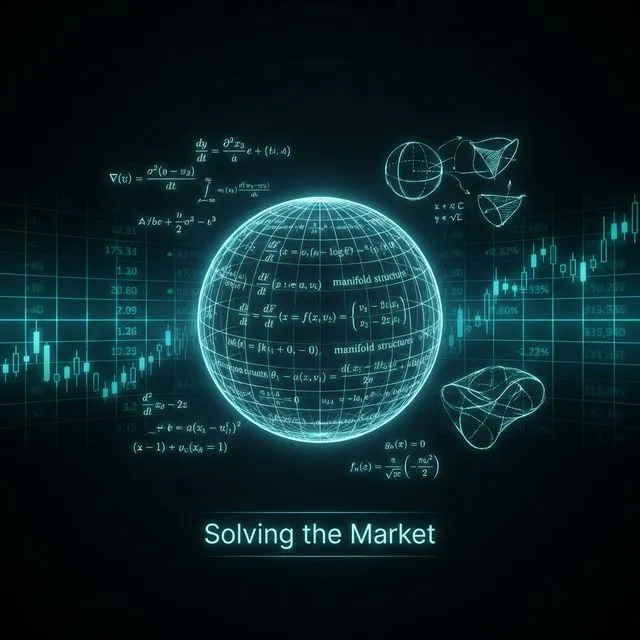



 Visualizing the Chern-Simons Invariant: How complex topology in geometry parallelled the hidden structures Simons found in financial markets
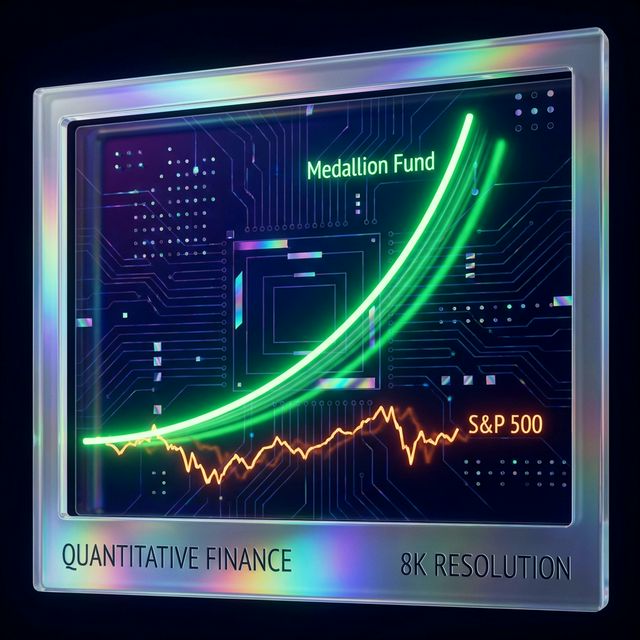 Medallion's Exponential Edge: A conceptual comparison of the Medallion Fund's consistent growth versus the volatile S&P 500 benchmark
 High-Frequency Sovereignty: A glimpse into the sophisticated, highly-secured server infrastructure powering the world's most successful quant models